
ForSyntax and Future Oriented Courses
A future oriented course teaches a child skills that will still matter in ten years, not skills that will be automated in two. At ForSyntax, all…
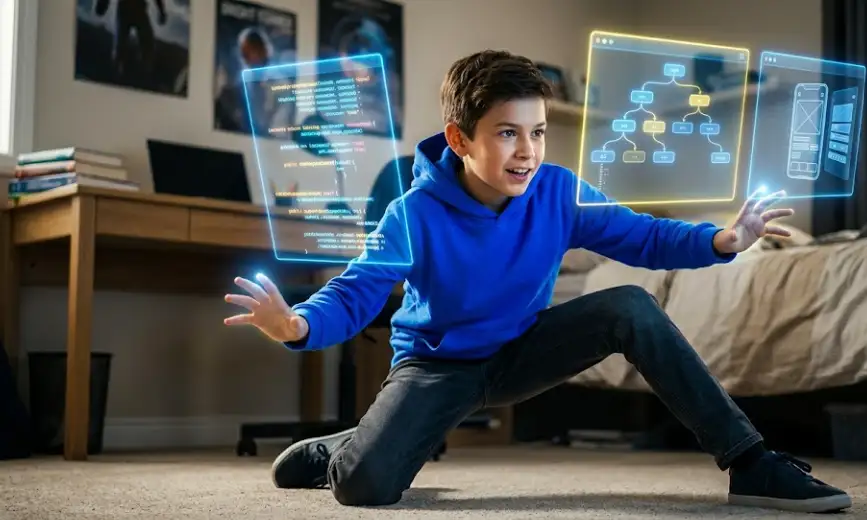
A future oriented course teaches a child skills that will still matter in ten years, not skills that will be automated in two. At ForSyntax, all nine of our courses are built around three things that do not go out of date: the ability to think in systems, the ability to build something real from nothing, and the ability to work alongside AI rather than compete with it. Every course, from Scratch Block Coding for a seven year old to Python AI and ML for a sixteen year old, is designed backwards from the world your child will actually enter.
Now let us explain what that means in practice, because “future ready” is a phrase every education company uses and almost none of them define.
What Parents Are Actually Worried About in 2026
We speak to a lot of parents. Across India, the UAE, the UK, the US, Singapore, and eleven other countries. The specific words change but the worry underneath is always the same.
“AI is doing everything now. Is coding still worth teaching my child?”
“My son spends five hours a day on his screen and I cannot tell if any of it is useful.”
“I do not want to spend money on a skill that will be obsolete before he finishes school.”
“How do I know what will actually matter when she is twenty-two?”
These are good questions. They deserve honest answers rather than marketing.
Here is our honest answer. Nobody knows exactly which tools will dominate in 2036. What we do know, with a high degree of confidence, is which capabilities will still be valuable. Those capabilities are what a genuinely future oriented course teaches. The tool is just the vehicle.
What “Future Oriented” Actually Means, Defined Properly
Most education companies use “future ready” to mean “we teach a technology that sounds modern.” That is not the same thing. Teaching a child a specific software package is not future oriented. It is present oriented, and the present moves.
A course is genuinely future oriented if it meets four tests.
Test one: Does it teach thinking, not just tools?
A child who learns the syntax of a language has learned something with a shelf life. A child who learns to break a large problem into small solvable steps, test their assumptions, and fix what breaks has learned something permanent. The syntax will change. The thinking will not.
Test two: Does the child produce something real?
Passive learning does not survive contact with the real world. A child who has watched forty videos about coding cannot code. A child who has built four working projects can. The difference is not information. It is the experience of having made a thing that did not exist before, hit problems, and solved them.
Test three: Does it prepare the child to work alongside AI, not against it?
This is the single biggest shift in education since the internet. The question is no longer “will AI take this job.” It is “will this person be able to direct AI effectively.” Children who understand how AI systems work, how to prompt them, where they fail, and how to verify their output will have an enormous advantage over children who either fear AI or trust it blindly.
Test four: Does it build something the child can show?
A portfolio is proof. When your child applies to a university programme, an internship, or a competitive school, a working app they built at twelve is worth more than a certificate saying they completed thirty lessons. We call this shipping, and every ForSyntax course ends with something shipped.
Every course we run is built to pass all four tests. Not three. All four.
The Three Skills That Will Not Go Out of Date
Underneath all nine ForSyntax courses sit three capabilities. Every course teaches all three, through a different subject and at a different level of depth.
1. Computational thinking
This is the ability to look at a messy real world problem and break it into steps a machine can execute. It is the skill underneath coding, but it applies everywhere. A child who has genuinely learned computational thinking approaches a chemistry problem, a logistics problem, or a business problem the same way: what are the inputs, what are the rules, what is the output, where does it break.
This transfers to school directly. Parents tell us this constantly. One parent, Vishal, told us that after two years of Python and web development, his son Reyansh’s problem-solving approach in schoolwork changed completely. That transfer is not accidental. It is the entire point.
If you want to understand how this works in practice, our guide on project based learning explains the methodology behind it.
2. Creation fluency
There is a category difference between a child who consumes technology and a child who creates with it. The consumer watches a game. The creator asks how the game handles collisions and then builds their own version.
This is the shift we mean when we say we turn screen time into shipping time. It is not about reducing screen hours. It is about changing what happens during them. We wrote about this in detail in Transforming Screen Hours: From Passive Watching to Active Learning, and it is the single most requested topic parents bring to us.
3. AI collaboration literacy
In 2026, this has moved from optional to essential. A teenager who can write a precise prompt, understand why the model produced a particular output, spot where it hallucinated, and integrate the result into something they are building has a genuinely different set of options ahead of them than one who cannot.
We do not teach children to be passive users of AI tools. We teach them to be the person directing the tool. Our full parent guide on this is Why AI Matters for Teenagers in 2026.
How Each ForSyntax Course Is Future Oriented
Here is the specific case for each of our nine courses. Not marketing claims. The actual reasoning.
Scratch Block Coding (Ages 7 to 18, 40 lessons)
Why it is future oriented: Scratch is not the future. Scratch is the doorway to it. What a seven year old learns in Scratch is sequence, loops, conditionals, events, and variables. These concepts are identical in Python, in JavaScript, in every language that will exist in twenty years. Scratch removes the syntax barrier so the child learns the thinking first.
The children who start here and move to Python later learn Python significantly faster than children who start with Python cold. The foundation is what makes the speed possible.
What your child builds: Working games with custom levels, animations, and interactive stories. Real, playable, shareable.
If you are deciding between starting here or going straight to text-based coding, our comparison of Python vs Scratch for kids will help.
Explore the Scratch Block Coding course
Python for Kids and Teens (30 lessons)
Why it is future oriented: Python is the language of AI, data science, automation, and scientific computing. It is the language most likely to still be dominant in a decade, because it sits underneath the entire machine learning ecosystem. A child who is genuinely comfortable in Python at fourteen has a direct on-ramp to almost every technical field they might choose at twenty.
What your child builds: Real applications and games. Not exercises. Working programs with actual functionality.
Aanya, aged eleven, built Cosmic Snake, a retro snake game with custom power-ups and levels, in six weeks. Two hundred and forty lines of Python. That is what month three of a serious Python course looks like.
Python AI and ML (40 lessons)
Why it is future oriented: This is the deepest future-facing course we run. Your child learns how machines actually learn. Not how to use an AI product, but how the underlying systems function: training data, models, predictions, evaluation, where models fail and why.
A teenager who understands this is not intimidated by AI. They are equipped to build with it. In a job market where every industry is being reorganised around machine learning, that difference is enormous.
What your child builds: Working AI models and smart projects. Real predictions on real data.
Explore the Python AI and ML course
AI Prompting and Prompt Engineering (30 lessons)
Why it is future oriented: Five years ago this course would not have existed. Today, the ability to communicate precisely with an AI system is a genuine professional skill with real economic value. It is also, notably, a skill that transfers into writing, thinking, and structured communication generally.
The children who learn this well are not learning to shortcut their thinking. They are learning to articulate exactly what they want, evaluate what comes back, and iterate. Those are the same skills that make a good engineer, a good researcher, and a good manager.
What your child builds: Creative AI projects, tools, and structured prompting systems they design themselves.
Explore the AI Prompting course
Flutter App Development (47 lessons)
Why it is future oriented: Mobile is not going away. Flutter lets a child build one app that runs on both Android and iOS. This is the course where children stop building things that live on a screen in a classroom and start building things that live on a phone in their pocket, and their parents’ pockets.
The moment a child installs an app they built themselves on their own phone is a genuine turning point. We see it happen repeatedly.
What your child builds: Real, installable mobile apps. Portfolio-ready. One of our students, Shaurya, moved into Flutter after a year of foundations and now builds working apps.
Explore the Flutter App Development course
App Development with AI and Coding (30 lessons)
Why it is future oriented: This course sits deliberately at the intersection of two futures: app building and AI integration. Children learn to build an application and then make it intelligent, connecting it to AI capabilities rather than treating AI as a separate subject.
This mirrors exactly how software is actually built in 2026. Nobody builds an app and then separately builds AI. The two are integrated from the start. We teach it the way it is actually done.
What your child builds: Applications with real AI functionality built in.
Explore the App Development course
Web Development (30 lessons)
Why it is future oriented: The web is the most durable platform in computing history. HTML has been in continuous use for over thirty years. A child who can build for the web can build something that works anywhere, for anyone, without asking anybody’s permission or paying for distribution.
More practically, this is the course that gives your child a portfolio site. A place to display everything else they have built. That artefact matters enormously when they are sixteen and applying to things.
What your child builds: Real websites and a personal portfolio.
Explore the Web Development course
Game Development
Why it is future oriented: Game development is the most complete technical education disguised as fun. To build a game a child must handle logic, mathematics, physics, state management, user experience, art, and debugging. It is genuinely one of the most demanding forms of software development, and children willingly do it for hours because they care about the outcome.
The motivation is the pedagogical advantage. A child will debug a game for an hour. They will not debug a worksheet for five minutes.
The Part Most Courses Get Wrong: Delivery
Curriculum is only half the equation. A future oriented curriculum delivered badly produces nothing.
This is where most online coding platforms fail. They record a course once, sell it a thousand times, and the child is alone with a video. The completion rates in that model are dismal, and the reasons are well understood. We have written about this in Why Children Quit Coding Classes in 3 Months.
Every ForSyntax course is live. There is a real mentor on the other side of the screen every single session. When your child is stuck, a human being diagnoses why they are stuck, which is something no recorded course and no app can do. A recorded course cannot tell the difference between a child who misunderstands loops and a child who has a typo. A live mentor can, in about fifteen seconds.
We offer four delivery formats because children are different:
Regular 1:1 for children who need full attention and a curriculum built entirely around their interests. One of our parents, Anitha, told us her son said “cricket” and his mentor built the entire curriculum around cricket.
Special Students 1:1 with trained special educators, for children with autism, ADHD, dyslexia, Down syndrome, and other learning differences. This is ForSyntax Inclusive, a dedicated wing with its own specialist educators, adaptive curriculum, and family-inclusive approach.
Small Group, 1:2 to 1:3 for children who learn better with a couple of peers alongside them.
Large Group, 1:4 to 1:5 for structured cohort learning at the most accessible price point.
If you are unsure which format suits your child, we wrote a full guide: How to Choose the Best Coding Session for Your Child.
Future Oriented Means Every Kind of Mind
We want to be direct about something.
A great deal of technology education is quietly designed for one type of learner. The confident child who processes verbal instruction quickly and does not mind being observed while struggling. Children who do not fit that profile get filtered out, and everybody involved concludes they are “not technical.”
We disagree with that conclusion completely.
Children with autism frequently thrive in coding environments precisely because coding has clear rules, immediate visual feedback, and no social ambiguity. Children with ADHD often sustain focus in a coding session far longer than in any other structured setting, because the feedback loop is fast enough to hold attention. We explained the underlying reasons in Coding as Structured Play: an ADHD and Autism Learning Guide.
ForSyntax Inclusive exists because these children deserve a genuinely future oriented education, not a simplified version of one. Same real projects. Same real skills. Different pacing, different pedagogy, specialist educators, and the same mentor every single session so that trust is never rebuilt from scratch.
If you want to see what this looks like in practice, read what we learned teaching a seventeen year old with autism to code. It is one of our first students, from Kerala, and the story is told honestly rather than triumphantly.
There is a second version of this filtering problem worth naming: girls opt out of technology far earlier than most parents realise, usually well before secondary school. We wrote about the specific mechanism and what parents can do in Coding for Girls: Why the STEM Gap Starts Earlier Than You Think.
Future oriented is not a real claim unless it applies to every kind of mind.
How to Tell if a Course Is Genuinely Future Oriented: A Checklist for Parents
Use this on any provider, including us. If a course cannot answer these clearly, be cautious.
Ask: What will my child have built after three months?
If the answer is a certificate, a completion percentage, or a number of lessons, that is not an outcome. If the answer is a specific working thing, that is an outcome.
Ask: Who is teaching, and is it the same person each week?
Consistency of relationship is a bigger predictor of a child continuing than curriculum quality. A rotating pool of instructors resets the relationship every session.
Ask: What happens when my child gets stuck?
The answer should involve a human diagnosing the specific misconception. Not a hint system. Not a forum. Not a chatbot.
Ask: Is the curriculum adapted to my child’s interests?
Motivation is the whole game with children. A child who wants to build a cricket app and is instead given a generic calculator exercise will disengage, and no amount of curriculum quality prevents that.
Ask: Does this course teach a tool or a way of thinking?
Both is ideal. Only a tool is a warning sign.
More detail on all of this: Is Your Child Ready for Coding? 7 Signs Parents Should Know and Live Coding vs Recorded Courses for Kids: An Honest Guide for Indian Parents.
What Actually Happens: Two Thousand Families, Fifteen Countries
We have over two thousand students enrolled across more than fifteen countries, including India, the UAE, the UK, the USA, Singapore, Canada, Australia, and Germany. Average parent rating is 4.9 out of 5, with a 98 percent parent satisfaction rate.
But numbers are less useful than specifics, so here are some specifics.
Yong Ming’s son Zavier, aged nine, joined with almost no exposure to coding. Nearly a year later he has developed both genuine interest and real skills, and has since added creative writing and maths. What his parent noted specifically was that he is now more confident in his school computer lab. The confidence transfer is the thing.
Sunita’s son Kiran, aged twelve, had tried other platforms that were too rigid. He has shipped four projects this year.
Priya’s son Arjun, aged ten, three months in, built a full quiz game. Her words were that he drags her over to watch what he has built. That is what engagement looks like when the child owns the output.
If you want to know what is realistic in the first month specifically, we set honest expectations here: What Should a Child Build by the End of Month 1 of Coding?
Where to Start
The honest answer is that it depends on your child’s age, current level, and what actually excites them. But here is a rough guide.
Ages 7 to 10, no prior experience: Start with Scratch Block Coding. Build the thinking, remove the syntax barrier, ship a game.
Ages 10 to 13, some prior experience: Python, then Web Development or Game Development depending on interest.
Ages 13 to 16, comfortable with basics: Python AI and ML, Flutter App Development, or RPA. These are the courses with the most direct line to real-world capability.
Any age, curious about AI specifically: AI Prompting is accessible from around age ten and pairs well with anything else.
Children with learning differences, any age from 6 to 16: Start with ForSyntax Inclusive and a free specialist demo session.
You do not have to decide from a webpage. That is what the free trial is for.
Try It Before You Decide Anything
A real sixty minute live class with a real mentor. No card required. No follow-up sales call if it is not right for your child.
Your child builds something in that session. Then you decide.
Frequently Asked Questions
What does “future oriented course” actually mean?
A future oriented course teaches capabilities that remain valuable as technology changes, rather than teaching a single tool that may become obsolete. At ForSyntax, this means every course is built around three durable skills: computational thinking, the ability to build real things from nothing, and the ability to work effectively alongside AI systems. The specific technology taught, whether Python, Flutter, or Scratch, is the vehicle for those skills rather than the destination.
Is coding still worth teaching children now that AI can write code?
Yes, and arguably more than before. AI writes code, but it does not decide what to build, verify whether the output is correct, understand why a system failed, or design the architecture around a problem. Children who understand code can direct AI effectively and catch its mistakes. Children who do not are entirely dependent on output they cannot evaluate. The skill has shifted from typing code to reasoning about systems, and reasoning about systems is exactly what our courses teach.
Which ForSyntax course is the most future oriented?
All nine pass the same four tests, so the honest answer is that it depends on your child’s age and interests rather than the course itself. That said, Python AI and ML goes deepest into how machine learning actually works, AI Prompting teaches the most immediately applicable new skill, and RPA teaches automation thinking that applies across almost every industry. For younger children, Scratch Block Coding builds the foundation that makes all the others possible.
What age should my child start a future oriented tech course?
We teach children from age 6 through 18. Ages 7 to 9 typically start with Scratch, ages 10 to 13 with Python, and ages 13 and above can start directly with AI, app development, or automation depending on prior experience. The better indicator than age is whether your child can focus on something they enjoy for around 20 minutes and is curious about how things work.
How is ForSyntax different from recorded coding courses and coding apps?
Every ForSyntax session is live with a real mentor, and your child works with the same mentor consistently rather than a rotating pool. A live mentor can diagnose why a child is stuck, which a recorded video or an app cannot do. Our curriculum is also personalised to each child’s interests rather than fixed, and every course produces real projects your child can show rather than a completion certificate.
Do you teach children with autism, ADHD, or other learning differences?
Yes. ForSyntax Inclusive is a dedicated wing with specially trained educators, adaptive multi-sensory curriculum, and a family-inclusive approach. It serves children aged 6 to 16 across India, the UAE, the UK, and the US. The same educator works with your child every session. A free demo session with a specialist educator is available before you enrol.
What will my child actually build?
Real, working, portfolio-ready projects. Our students have built playable games with custom levels, mobile apps installable on a phone, AI chatbots, working websites, robot navigation programs, and automation tools. One eleven year old built a complete Python game with custom power-ups in six weeks. Projects are chosen around each child’s interests, so a child who loves cricket builds cricket-related projects.
How many countries does ForSyntax operate in?
We have over 2,000 students across 15 or more countries, including India, the UAE, the UK, the USA, Singapore, Canada, Australia, and Germany. Sessions are scheduled around your local time zone, so families outside India are fully supported.
Is there a free trial, and is there any obligation?
Yes, and no. The trial is a real 60 minute live class with a real mentor. No card is required. If it is not right for your child, there is no follow-up sales call.
How much do ForSyntax courses cost?
Per month for one-to-one, with 8 and 12 session options available at each level. ForSyntax Inclusive plans with specialist educators. Full details are on our pricing page.
