
Why AI Matters for Teenagers in 2026: A Parent’s Complete Guide
Short answer: AI matters for teenagers because it is changing what entry level work looks like in almost every field they might enter. Teenagers who understand…
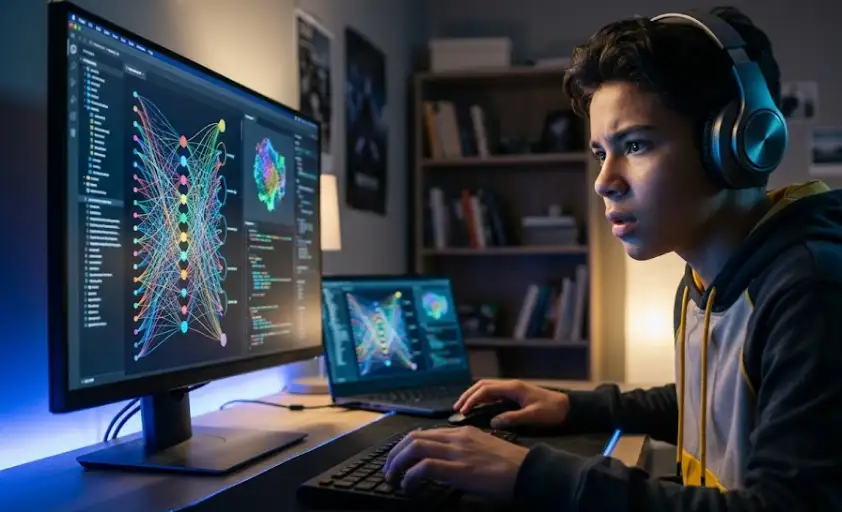
Short answer: AI matters for teenagers because it is changing what entry level work looks like in almost every field they might enter. Teenagers who understand how AI systems actually work, rather than just using them as shortcuts, will be able to direct these tools instead of competing with them. The window to build this understanding is roughly ages 13 to 18, when teenagers have the abstract reasoning to grasp how AI models work and enough time before university to build real projects.
That is the compressed version. The rest of this article explains what that actually means for your teenager, what skills matter and which ones do not, and how to tell the difference between an AI course worth your money and one that is selling hype.
The uncomfortable question most parents are asking
If AI can write code, write essays, and answer almost any question, why should my teenager bother learning any of it?
It is a fair question and it deserves a straight answer rather than a reassuring one.
Here is the honest version. AI is very good at producing plausible output quickly. It is not good at knowing whether that output is correct, appropriate, or solving the right problem. That judgement gap is where every meaningful job now sits. A teenager who can only use AI to produce answers is competing with every other teenager who can do the same thing. A teenager who understands why an AI gave a particular answer, where it is likely to be wrong, and how to structure a problem so the AI is actually useful is doing something entirely different.
The skill is not using AI. The skill is directing it.
What is actually changing in the world your teenager will enter
Three shifts are worth understanding, because they explain why this is different from previous technology waves.
The entry level rung is moving up. Tasks that used to be given to junior employees to learn on, drafting first versions, summarising documents, writing basic scripts, running standard analyses, are increasingly automated. This does not eliminate entry level work but it changes what an employer expects a new graduate to already be able to do. The bar for “useful on day one” has risen.
AI literacy is becoming a baseline expectation, not a specialisation. In 2020, knowing how to use AI was a differentiator. In 2026, it is closer to what spreadsheet literacy was in 2005. It is expected, not remarkable. What is remarkable is the ability to build with AI rather than only consume it.
Every field is affected, not just tech. A teenager who wants to be a doctor will use AI diagnostic tools. One who wants to be a lawyer will work alongside AI research systems. One who wants to be a journalist, designer, teacher, or entrepreneur will face the same reality. This is why framing AI as “a computer science topic” misses the point entirely.
We should be honest about the uncertainty here. Nobody can predict exactly which jobs will exist in 2035 or what they will require. What we can say with reasonable confidence is that the ability to understand, evaluate, and direct AI systems is unlikely to become less valuable. That makes it a low regret skill to build now.
What teenagers should actually learn about AI
This is where most AI courses for teenagers go wrong. They either teach nothing but prompt writing, which is shallow and will be obsolete quickly, or they teach university level machine learning mathematics, which is inappropriate for most 14 year olds and kills interest fast.
The right middle ground has four parts.
1. How AI systems actually work, at a conceptual level
Your teenager does not need to derive backpropagation equations. They do need to understand what a model is, what training data is, why AI systems make confident mistakes, and why the same question can produce different answers. This conceptual foundation is what separates a teenager who trusts AI blindly from one who evaluates it.
A good indicator: after a few months of proper learning, your teenager should be able to explain to you why an AI chatbot sometimes invents facts. If they can explain that clearly, they understand something important.
2. Building with AI, not just prompting it
There is a large difference between asking ChatGPT to write an essay and building an application that uses an AI model to solve a specific problem. The second is where actual learning happens.
Teenagers who build AI projects learn to define a problem clearly, structure inputs and outputs, handle cases where the AI fails, and evaluate whether the result is good enough. These are transferable thinking skills that apply far beyond AI.
Practical projects that work well for this age group include a study assistant that generates practice questions from a syllabus, an AI powered chatbot for a school club, a tool that sorts and summarises information for a personal project, or an automation that connects several apps together to remove a repetitive task.
3. AI automation, which is the most underrated skill
Most attention goes to generative AI. Less attention goes to automation, which is arguably more immediately useful. Automation is about connecting systems so that repetitive work happens without a human doing it every time.
A teenager who learns to build automations is learning to see processes rather than tasks. That is a genuinely rare way of thinking and it is directly employable. It is also immediately satisfying because the results are visible. An automation that saves a parent 20 minutes a week is a project a teenager can show and be proud of.
4. Judgement, ethics, and knowing when not to use AI
This is the part that gets skipped and should not be. Teenagers need to think about bias in training data, privacy, when using AI is appropriate and when it is essentially cheating themselves out of learning, and what happens when AI systems are wrong at scale.
This is not a lecture module. It comes up naturally when a teenager builds something and discovers their AI model behaves oddly with certain inputs. That moment of confusion is the best possible entry point into a conversation about how these systems fail.
At what age should a teenager start learning AI
Around 13 is a reasonable starting point for structured AI learning, though there is nothing magic about that number.
The reason 13 works is developmental rather than technical. Around this age, most teenagers have developed the abstract reasoning to hold a concept like “the model does not know things, it predicts likely next words” without needing it made concrete. Younger children can absolutely use AI tools and enjoy them, but the conceptual understanding tends to land better in the early teens.
Ages 13 to 15 are ideal for building foundations: understanding how models work, building first AI powered projects, learning basic Python if they have not already. Ages 16 to 18 are ideal for depth: building substantial projects, exploring automation seriously, and creating a portfolio that means something for university applications and early opportunities.
If your teenager is 17 and has done nothing with AI yet, that is not a problem. Motivated teenagers move quickly. What matters more than starting age is starting with the right structure.
Why most teenagers give up on AI learning within two months
This is worth stating plainly because it is the most common outcome and it is avoidable.
Teenagers abandon AI courses for three predictable reasons. The content is either too abstract, meaning weeks of theory before they build anything, or too shallow, meaning they finish and cannot do anything they could not do before. There is no accountability, which matters enormously for teenagers who are already balancing school, exams, and social life. And there is no project they personally care about, which means the work feels like extra homework rather than something they chose.
The fix for all three is the same. Build something real in the first session. Have a person who is expecting them to show up. Let them choose a project that connects to something they already like, whether that is gaming, music, sport, art, or a subject they are studying.
Recorded courses struggle with all three of these. A teenager who does not understand something in a recorded lesson cannot ask why. A teenager who skips a week faces nothing. This is not an argument that recorded courses are useless. It is an observation that they have a high dropout rate for teenagers specifically, which most parents discover only after paying.
How to evaluate an AI course for your teenager
Five questions worth asking any provider before you pay.
What will my teenager build in the first month? If the answer is vague or focused on “understanding concepts”, the course is likely too theoretical. There should be a concrete, nameable thing.
Is there a live teacher, and do they interact with my child individually? Recorded content plus a support forum is not the same as a teacher who notices your teenager is confused about a specific idea and explains it differently.
Can my teenager choose their own project? Fixed curriculum projects work for some teenagers and lose others entirely. Flexibility here is a strong signal.
What happens if my teenager falls behind during exam season? Any honest provider working with teenagers has an answer for this, because it happens to almost everyone. Rigid schedules produce dropouts.
Can I see what other students have actually built? Real project outputs are the only meaningful proof. Testimonials about how much a child “loved the class” tell you nothing about whether they learned anything.
How ForSyntax approaches AI for teenagers
We run live 1:1 and small group sessions for teenagers, focused on building rather than lecturing. Our Gen AI and AI Automation programmes are structured so that a teenager builds something functional in their first session and continues building from there.
There are no recordings. Every session is live with a mentor who adapts to how your teenager thinks, what they are curious about, and what pace works for them. If exam season hits, sessions reschedule without penalty. If your teenager wants to build an AI tool related to their favourite game rather than the standard curriculum project, that is usually a better outcome and we will do that instead.
Parents get direct visibility. You see what your teenager built, you can speak to the mentor whenever you want, and you are not guessing whether progress is happening.
Book a free live session and see what your teenager builds in the first hour. No commitment, no sales pressure, just a real session with a real mentor.
Frequently Asked Questions
Should teenagers learn AI if they do not want a career in technology?
Yes, and arguably more so. AI tools are now embedded in medicine, law, journalism, design, business, and education. A teenager planning a non technical career benefits from understanding AI as a tool they will direct rather than a black box they defer to. The goal is not to make them a machine learning engineer. It is to make them someone who is not intimidated by these systems.
What is the best age for a teenager to start learning AI?
Around 13 works well for structured learning, because most teenagers by then have the abstract reasoning to understand how AI models work conceptually. Ages 13 to 15 suit foundation building. Ages 16 to 18 suit deeper projects and portfolio work. Starting later is entirely workable, since motivated teenagers progress quickly.
Does my teenager need to know coding before learning AI?
Not to start. Many AI concepts and automation projects can be built with minimal coding. That said, basic Python significantly expands what your teenager can build and most well structured AI programmes for teenagers introduce it gradually alongside the AI work rather than requiring it upfront.
Is using AI to do homework harmful for teenagers?
It depends entirely on how it is used. A teenager who asks AI to write their essay learns nothing. A teenager who writes a draft, asks AI to critique it, and then decides which criticisms are valid is doing something genuinely useful. The difference is whether the AI replaces the thinking or supports it. This is a conversation worth having explicitly rather than assuming your teenager will work it out.
Will AI take away the jobs my teenager is preparing for?
Some tasks within many jobs are being automated. Complete job elimination is happening more slowly and less broadly than headlines suggest. The more useful framing is that jobs are changing shape rather than disappearing, and the people who adapt fastest are those who understand the tools rather than avoiding them. Nobody can predict this precisely, which is exactly why building adaptable skills matters more than betting on a specific career path.
What can a teenager realistically build with AI in three months?
With consistent live sessions, a reasonable outcome is two or three functional projects. Examples include a chatbot trained on a specific topic, an automation that connects multiple apps to remove repetitive work, an AI powered study tool that generates practice questions, or a simple application that uses an AI model to solve a defined problem. The specific projects matter less than the fact that they exist and your teenager can explain how they work.
Is live 1:1 AI teaching actually better than a recorded course for teenagers?
For most teenagers, yes, and the main reason is accountability rather than content quality. Recorded courses have high dropout rates among teenagers because there is no person expecting them to show up and nobody to ask when they are stuck. A live mentor can also diagnose why a teenager is confused, which a recorded video cannot do. Recorded courses work well for highly self motivated teenagers, which is a smaller group than most parents expect.
How much should AI learning cost for a teenager?
This varies significantly by format and region. Live 1:1 instruction costs more than group or recorded formats, and whether that premium is worth it depends on your teenager. A useful way to think about it is cost per outcome rather than cost per hour. A cheaper course your teenager abandons after five weeks is more expensive than a costlier one they complete.
Can teenagers with ADHD or autism learn AI effectively?
Frequently yes, and often very well. Coding and AI work provides clear rules, immediate visual feedback, and unambiguous outcomes, which many neurodiverse learners find easier to engage with than open ended subjects. What matters most is the teaching format. Live 1:1 sessions that adapt pace and communication style tend to work considerably better than fixed group instruction for these learners.
How do I know if my teenager is actually learning or just using AI to look productive?
Ask them to explain how their project works without showing you the screen. If they can describe what problem it solves, why they built it that way, and what they would change, they understand it. If they can only show you the output, the AI did the work and they watched.
