
What We Learned Teaching a 17 Year Old With Autism to Code
I did not expect the first session to go well. Darshu sat across from the screen, arms crossed, eyes elsewhere. He had been brought to the…
I did not expect the first session to go well.
Darshu sat across from the screen, arms crossed, eyes elsewhere. He had been brought to the laptop by his mother, who had spent weeks researching, hoping, and honestly, probably doubting. He had not asked to be there. He did not want to code. He did not want to talk to me either.
That first session, I did not teach a single line of code.
I am sharing this because I think most people imagine a child sitting down, opening a laptop, and falling in love with coding in the first hour. Sometimes that happens. With Darshu, it took longer. And what happened over the following weeks taught me more about teaching than any course or certification ever did.
Why I Started Working With Autistic Students
When ForSyntax began, our focus was straightforward: teach children to build real things with code. Games, apps, scripts. Not theory. Not worksheets. Real, working projects they could show their family.
But early on, parents of neurodiverse children began reaching out. Quietly, tentatively, almost apologetically, as if they already expected to be told their child was not suitable.
That assumption, that a child with autism cannot learn to code, is not just wrong. In my experience, it is almost exactly backwards. Many autistic learners have an extraordinary relationship with systems, logic, patterns, and rules. Coding is built from systems, logic, patterns, and rules. The fit is often natural. The barrier is rarely the child. The barrier is usually the approach.
The Counselling Session That Changes Everything
Before any student with additional learning needs joins ForSyntax, we run a dedicated counselling session. This is not a sales call. It is not an assessment in the academic sense. It is a conversation, with the student and their family, where we listen far more than we speak.
We ask: What does this child love? What frustrates them? What does a bad day look like, and what does a good day look like? What has worked in other learning environments and what has completely failed? Does this child need silence or background noise? Do they need to know exactly what is coming, or do they tolerate surprise?
Every answer shapes the learning plan we build before the first session begins. That plan is not a template. It is written for one child.
With Darshu, the counselling session told us several things immediately. He responded to visual information far better than verbal instruction. Abstract concepts needed to be grounded in something real and familiar to him before they would land. He needed to feel in control of the session, not directed through it. And he needed time, real time, before he would trust a new person enough to engage.
So on day one, I did not teach. I let him show me things he liked. I asked questions about his interests. I made no demands on the laptop at all.
The Approach That Finally Worked
Most teaching methods for coding follow a logical sequence. Variable, then loop, then condition. Build from the bottom up, concept by concept.
For Darshu, this approach produced a wall. The concepts were too abstract, too detached from anything he cared about. Why does a loop matter? What is a variable actually for? Without a real-world anchor, the words did not stick.
So we changed the approach entirely.
Instead of explaining what a variable is in the abstract, I said: imagine this box in the code is like your cousin Arjun. Sometimes Arjun is happy, sometimes he is tired, sometimes he is excited. The box holds his mood, and the mood changes. That is all a variable is. A box that can hold different things at different times.
It sounds simple. And it is. But for Darshu, attaching the logic of code to names and relationships he knew, people and situations from his real life, transformed abstract syntax into something he could actually picture. A function became something his uncle did every morning without being reminded. A condition became the rule his mother followed when deciding whether to make tea or coffee depending on who was home.
We did not invent this approach in a textbook. We found it through weeks of trying different things and watching carefully for what made Darshu lean forward instead of pull away.
He began leaning forward.
The Day His Mother Cried
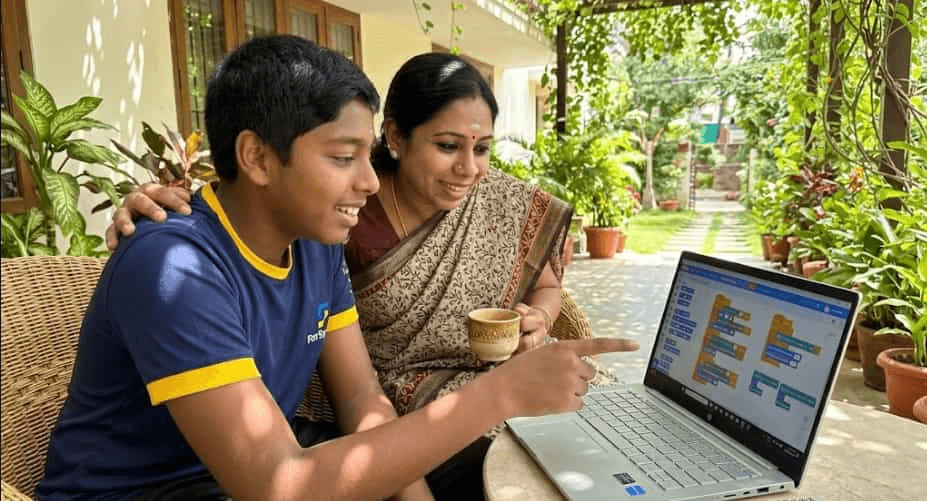
About two months into the programme, Darshu completed his first working game.
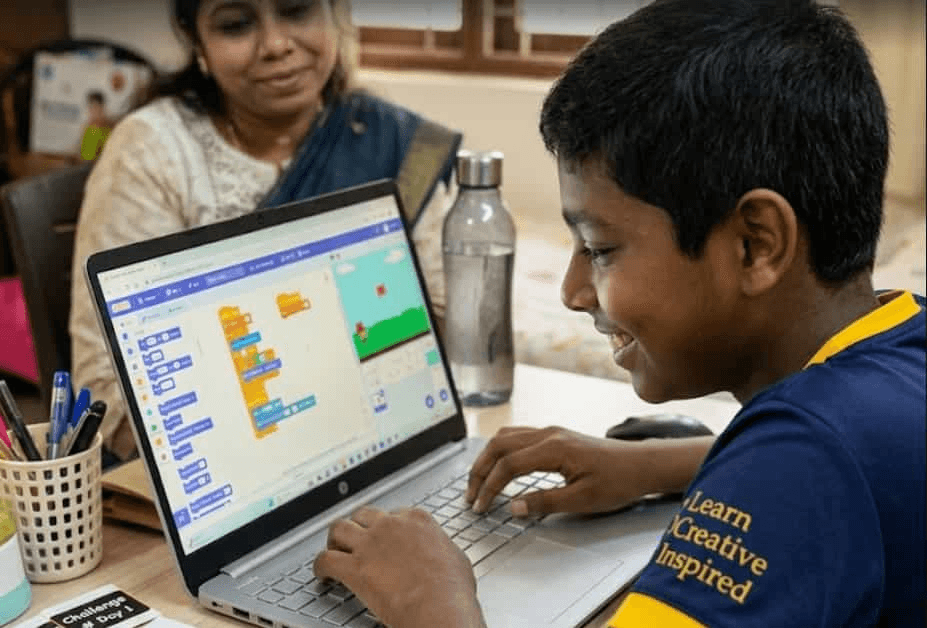
It was built in Scratch. It was not complicated by any external standard. A character moved. An obstacle appeared. A score went up. The game worked because Darshu had written every part of it, tested it, fixed it when it broke, and tested it again.
His mother was watching.
I have taught many students. I have seen children proud of what they built. But I have rarely seen a parent’s face change the way his mother’s did in that moment. It was not just pride. It was something closer to relief, and recognition. Her son, who had resisted every previous learning environment, who had sat with his arms crossed in my first session, had built something. Something that worked. Something he had made.
He was genuinely happy. Not performed happiness, not polite engagement. He was actually happy.
I think about that moment often, especially when I am preparing a plan for a new student and wondering whether the approach will work.
What Autism Actually Taught Me About Teaching
I want to be careful here, because autistic learners are not a single category. Darshu’s autism presents differently from another student I worked with the same year, and differently again from a third student currently in the programme. One framework does not cover all three.
But working with autistic students at ForSyntax has permanently changed how I approach every student, neurodiverse or not.
The first thing I learned is that resistance is almost never disinterest. Darshu looked disengaged in session one. He was not disengaged. He was assessing. He was deciding whether this was safe, whether I was trustworthy, whether the environment was predictable enough to relax into. Once he decided it was, his engagement was total.
Most teaching systems interpret resistance as refusal and respond by increasing pressure. I have found the opposite works better. Reduce the demand. Increase the familiarity. Wait. The engagement usually follows.
The second thing I learned is that the anchor matters more than the content. Darshu did not learn what a variable is by being told what a variable is. He learned it by connecting it to something he already understood. Every time I introduce a new concept now, to any student, I look for the anchor before I explain the concept. What does this student already know that I can attach this to?
The third thing I learned is that genuine success, a real working project the student built themselves, does more for learning momentum than any amount of encouragement or praise. Darshu’s game was his proof. Not my assessment of him. His own evidence that he could do this. That kind of proof cannot be given. It has to be built. Which is why every ForSyntax student builds something real from week one, not in month six.
Why We Made This a Formal Initiative, Not Just a Course
About two months into the programme, Darshu completed his first working Scratch project (you can see his daily coding challenges over on their Instagram at
ForSyntax Inclusive was not initially planned as a product. It grew from what we were already doing for students like Darshu and the realisation that the approach we had developed was genuinely different from what was available elsewhere.
Every student who enrolls in ForSyntax Inclusive begins with a counselling session. Every learning plan is individual. Every session is live and 1:1, which means the teacher adapts in real time to what is working and what is not. There are no recordings, no self-paced modules, no automated check-ins. There is a teacher, a student, and a plan built specifically for that student.
This is not scalable in the way a recorded course is scalable. We know that. We have chosen it deliberately.
Because what Darshu needed was not a platform. He needed a person who was paying attention specifically to him. His mother needed to know that person existed and was accountable. And he needed to build something real enough that neither of them could argue with the evidence.
We are expanding this programme globally. Not because it is the easiest thing to scale, but because the need exists everywhere and almost nobody is meeting it.
If you are a parent of an autistic child who has been told that online learning will not work for your child, I would gently push back on that. The question is not whether online learning works. The question is whether the approach is right for your child. Those are very different questions, and the second one has a much more interesting answer.
What I Would Tell Any Parent Reading This
If your child did not engage in the first session, that is not the answer.
If your child has tried other programmes and they have not worked, that is not the answer either.
The approach matters more than the medium. The relationship matters more than the curriculum. The anchor matters more than the concept.
If you would like to talk about whether ForSyntax Inclusive might be right for your child, we start with a counselling session, not a sales pitch. We listen first. We plan second. We teach third.
That is the order that works.
And somewhere, Darshu is probably still building games.
Frequently Asked Questions
What age does ForSyntax Inclusive accept students?
We currently work with children and young people from age 7 through 18. Darshu joined at 17, which is a reminder that there is no age at which it is too late to start. Our approach adapts to the age and maturity of the learner, not a fixed curriculum ladder.
What happens in the counselling session before enrolment?
The counselling session is a one-to-one conversation between our educators and the student’s family. We ask about the child’s interests, communication preferences, what has worked in previous learning environments, what has not, and what a good day looks like for your child. From this conversation, we build a learning plan before the first session begins. The counselling session costs nothing and commits you to nothing.
Does my child need to have any prior coding experience?
No. Darshu had none. Most of our inclusive students begin with no prior coding experience. We start exactly where your child is, not where a syllabus says they should be.
What platform or language do you use for beginner students?
We begin with Scratch for most students, particularly younger learners and those who respond well to visual, immediate feedback. Scratch allows a child to see the result of their code in real time, which removes a significant source of frustration for many neurodiverse learners. We move to Python and other languages when the student is ready and interested, not on a fixed schedule.
What if my child refuses to engage in the early sessions?
This happens. It happened with Darshu. Our educators are trained to work with resistance rather than against it. In early sessions, we prioritise building trust and familiarity over covering content. We do not escalate demands when a child pulls back. We reduce them, and we wait. The engagement almost always follows when the environment feels safe.
How is a live 1:1 session different from a recorded course for an autistic child?
A recorded course cannot adapt. If your child is confused, the recording continues. If your child needs a different explanation, the recording offers only the one it has. A live 1:1 session adapts in real time. The teacher sees the child’s face, hears their voice, notices when engagement drops, and changes approach immediately. For neurodiverse learners who may need multiple different explanations of the same concept before one lands, this real-time adaptability is not a luxury. It is essential.
Is ForSyntax Inclusive available for students outside India?
Yes. We currently have students in UAE, UK, US, China etc.. Because sessions are fully online and live, a student in Dubai, London, or anywhere with a reliable internet connection can access exactly the same programme as a student in Kerala. We adjust session timing to suit your timezone.
How do I know if ForSyntax Inclusive is right for my child specifically?
We do not think you should decide that from awebsite. Book a counselling session. Bring your questions, your doubts, and your child’s full history if you want to share it. We will be honest with you about whether we think we are the right fit. If we are not, we will say so. We would rather lose an enrolment than take on a student we cannot genuinely serve.
What does a typical first month look like for a student in the inclusive programme?
We schedule regular parent check-in calls with the educator, not an automated report. You speak to the person teaching your child. We discuss what is working, what the next phase of the learning plan looks like, and any adjustments we are considering. You are part of the plan, not just the recipient of a progress percentage.
