
How Live 1:1 Coding Works Differently for Neurodiverse Children
When a parent of a child with autism first messages us, the opening line is almost always the same. “I am not sure coding is for…
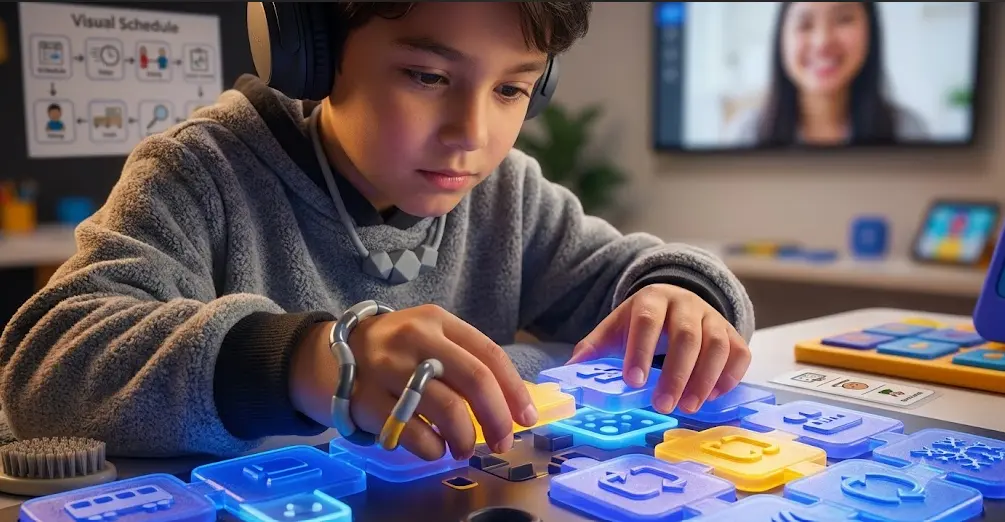
When a parent of a child with autism first messages us, the opening line is almost always the same. “I am not sure coding is for my child.” By the end of the first session, that same parent is sending us a screenshot of what their child just built, asking when the next class is.
I have seen this happen more times than I can count now. Not because we do something magical. Because we do something simple that most online education has never bothered to do: we show up, in person, one to one, and we meet the child exactly where they are.
This blog is for every parent who has been told, directly or indirectly, that their neurodiverse child is not a good fit for something. We want to tell you what we have actually seen, from inside real sessions, with real children, and why live 1:1 coding works differently for neurodiverse learners than anything else we have tried.
What Most Online Learning Gets Wrong for Neurodiverse Children
Before we talk about what works, it is worth naming what does not.
Recorded courses assume every child learns at the same pace, stays engaged through the same formats, and is motivated by the same outcomes. They are built for the average learner. The average learner does not exist, and for neurodiverse children, the gap between what a recorded course assumes and what the child actually needs is often enormous.
A child with ADHD cannot pause a recorded lesson and pick it up three days later with the same engagement. A child with autism may get stuck on one concept and need it explained four different ways before it clicks. A child with dyslexia does not need less content, they need content presented differently. A child with sensory processing differences may have a day where everything is overwhelming, and a rigid scheduled group class has no room for that reality.
Group live classes are better than recordings but carry the same fundamental problem in a different form. When twelve children are in a virtual classroom, the teacher cannot watch one child getting quietly lost while continuing to explain something to the other eleven. The child who needs the most responsive teaching gets the least of it.
This is not a criticism of teachers in those environments. It is a structural problem. The format prevents the responsiveness the child needs.
Live 1:1 removes the structure that creates the problem. When it is one child and one teacher, everything changes.
What We Have Learned Teaching Neurodiverse Children to Code
ForSyntax works with children across a wide range of learning profiles including autism spectrum disorder, ADHD, dyslexia, and sensory processing differences. What follows is not theory. It is what we have observed across many sessions with real children, refined over time, and built into how we teach.
The session belongs entirely to the child
In a 1:1 session, there is no other child’s pace to follow. If a child needs to spend the entire first session understanding what a variable is, we spend the entire first session on that. If a child grasps the first five concepts in twenty minutes and wants to immediately start building something, we build something.
This sounds obvious. In practice, it changes everything for neurodiverse learners because their learning rarely follows a predictable arc. They may absorb something instantly and then need to return to it three sessions later from a different angle. They may resist a concept for weeks and then suddenly own it completely. A rigid curriculum delivered on a fixed schedule does not accommodate this. A 1:1 session does, because the session belongs entirely to the child in front of us.
The output is always visible and always real
One of the most consistent things we have observed across neurodiverse learners is the power of immediate, visible output. When a child writes a line of code and something happens on the screen in front of them, that feedback loop is instant and unambiguous. The code either works or it does not. There is no social interpretation required, no reading of a teacher’s expression, no wondering whether the answer was right enough. The screen tells the truth.
This is particularly significant for children on the autism spectrum. Many of our autistic students respond to coding with an engagement we rarely see them bring to other subjects, precisely because it is predictable. Coding has rules. The rules are consistent. If you follow the rules, the output is what you expect. If something goes wrong, there is a reason, and finding that reason is a solvable puzzle. For a child who finds social unpredictability exhausting, the logical clarity of coding is not just manageable. It is deeply satisfying.
We adjust pacing in real time, not after the fact
In a recorded course, pacing is fixed. In a group class, pacing is averaged. In a 1:1 session, pacing is continuous and responsive.
Our teachers are trained to read the session moment by moment. When a child’s engagement drops, we do not continue the planned lesson. We change direction. We might switch from explaining to doing. We might introduce a mini challenge. We might take a two-minute break where the child talks about something they care about, and then return. With children who have ADHD, this responsiveness is not a nicety. It is the difference between a session that produces learning and a session that produces frustration.
We have also learned that “taking a break” looks different for every child. For some children it means stopping entirely for two minutes. For others it means switching from text-based code to a visual drag-and-drop interface for a while. For others it means the teacher stops talking and just watches the child try something on their own. The teacher adjusts in real time because they can see exactly what the child is doing, on a shared screen, throughout the entire session.
We present the same concept multiple ways without being asked
A child with dyslexia may read an instruction on screen and not retain it. The same instruction spoken aloud lands differently. The same instruction demonstrated visually lands differently again. In a 1:1 session, our teachers do all three as a matter of course, not as a special accommodation. The child never has to ask for help in a way that makes them feel different from the others, because there are no others. There is just the teacher and the child and the task.
This matters more than parents sometimes initially realise. Many neurodiverse children arrive at ForSyntax having already learned that asking for help draws attention to their difference. They have developed sophisticated ways of appearing to follow along while actually being lost. In a 1:1 session, there is no group to hide in. But there is also no group to feel different from. The relationship between teacher and student is entirely private, and within that privacy, most children drop their guard within a few sessions and begin asking for exactly what they need.
The child builds something real from session one
We start building in the first session. Not as an end-of-unit reward, not as a demonstration, but as the actual substance of the session. The child writes code. Something appears on the screen. They made that happen.
For neurodiverse children who have often been positioned as needing more support, more accommodation, more time than other children, this moment of visible competence carries a weight that goes beyond the project itself. We have had parents tell us their child came home and spent three hours extending what they built in class, something that had never happened with school homework. We have had children who had refused to engage with structured learning for months sit through a ninety-minute session without once asking to stop, because they were building something they wanted to finish.
Coding does not ask neurodiverse children to be more like neurotypical children. It asks them to think logically, build systematically, and solve problems creatively. Many neurodiverse children are exceptionally good at exactly these things. The medium suits them. The live 1:1 format removes every barrier between them and the medium.
How We Approach Each Condition
The National Autistic Society, the UK’s leading autism charity
Autism Spectrum Disorder
Children on the autism spectrum often thrive in coding environments because the medium itself is well-suited to how they think. Coding has clear rules, predictable outcomes, and no ambiguity. When something does not work, there is always a specific reason, and finding that reason is a puzzle with a correct answer.
In our sessions with autistic learners, we consistently use visual-first teaching. We show rather than describe wherever possible. We explain transitions explicitly before they happen, so the child knows what is coming next. We allow the child to dictate the direction of the session within the curriculum framework, because self-direction significantly increases engagement for most autistic learners. We do not use metaphors or abstract language to explain coding concepts without also demonstrating exactly what we mean concretely.
We also never rush. If a child wants to spend an additional fifteen minutes perfecting something before moving on, we stay. The session serves the child, not the schedule.
ADHD
Children with ADHD often have intense interests and high capability alongside genuine difficulty sustaining attention on content that does not capture them. Coding, when presented as building something the child cares about, frequently becomes one of those intense interests. The challenge is getting from the first exposure to the point where the child has built something that hooks them. That is where 1:1 teaching is most critical.
In our sessions with children who have ADHD, we keep the goal visible at all times. We say at the start of every session: “By the end of today, here is what you will have built.” We check in every ten to fifteen minutes with a tangible milestone so the child can see that they are making progress. We use variety deliberately, switching between writing code, testing the output, debugging, and designing elements, so the session never stays in one mode long enough for attention to drift.
We also use the child’s specific interests as the context for coding projects wherever possible. A child who is passionate about football might build a football score tracker. A child who loves animals might build a quiz about endangered species. The coding concepts are identical regardless of the theme. The engagement is not.
Dyslexia
Children with dyslexia are frequently underestimated in technical subjects because reading-heavy learning environments disadvantage them. Coding is not inherently reading-heavy. The amount of text in a line of code is minimal. The logic is visual and structural. Many children with dyslexia take to coding quickly once they are in an environment that presents it through demonstration and doing rather than through reading.
In our sessions with dyslexic learners, we minimise on-screen text instruction. We explain verbally, demonstrate on the shared screen, and then invite the child to try. We do not ask children to read long passages of documentation. We break every concept into the smallest possible step and demonstrate each step before asking the child to reproduce it. We also give children extra time to process after each explanation without filling the silence. For many dyslexic learners, the processing time is as important as the explanation itself.
We have consistently found that children with dyslexia who come to us having struggled in school perform at or above the level of their peers in coding within a few months. Not because coding is easier for them, but because the format of 1:1 live teaching removes the barriers the written-word-heavy school environment was creating.
Sensory Processing Differences
For children with sensory processing differences, the online 1:1 format has a structural advantage that is rarely discussed: the child learns from their own home environment, which they have already calibrated for their sensory comfort. There is no classroom fluorescent lighting, no unpredictable noise from thirty other children, no physical proximity to others that may be overwhelming. The child is in a space they control.
Within the session itself, we allow the child and parent to set the conditions. Some children do their best work with noise-cancelling headphones on. Some need the camera off for the first few sessions until they feel comfortable. Some need a five-minute settling routine at the start of every session before moving into content. All of this is not only possible in a 1:1 live session, it is easy, because there is no group to manage and no format that requires every child to be present in the same way simultaneously.
We also pay attention to sensory load within the coding environment itself. We default to clean, minimal interfaces without unnecessary animations or visual noise. We let the child choose their colour scheme and display settings where possible. These are small adjustments that take thirty seconds and make a significant difference to a child who finds sensory overload a genuine obstacle to learning.
What Parents Tell Us
We hear a version of the same thing repeatedly from parents of neurodiverse children who enroll with ForSyntax. The exact words differ but the shape is consistent.
“I did not expect them to last the first session.”
“They came home and wanted to show everyone what they built.”
“This is the first structured activity they have not asked to stop.”
“They have started talking about what they want to build next.”
We do not share these because they reflect well on us. We share them because they reflect well on the children. These are children who were already capable. They needed a format that got out of their way.
ForSyntax Inclusive Alpha: What It Is
ForSyntax Inclusive Alpha is our live 1:1 coding programme specifically designed for neurodiverse learners. It is not a modified version of our standard programme. It is built from what we have learned teaching neurodiverse children over time, incorporating the specific approaches described above.
Every session is one teacher to one child. There is no group, no recorded content, no fixed-pace curriculum that the child must keep up with. The child’s learning profile, interests, and pace shape the session. Parents receive a brief update after every session and are welcome to join a monthly check-in call.
We start with Scratch for most students because the immediate visual output reinforces the feedback loop that works so well for neurodiverse learners. Students move through Scratch into Python when they are ready, not when the calendar says they should be.
The goal by the end of the first month is simple. The child has built something real. They know they can do it. They want to come back.
See one of our child’s success Story: See Now
If your child has been told they are not a good fit for structured learning, we would like to respectfully disagree.
Research published in PLOS ONE
Frequently Asked Questions
What age does ForSyntax Inclusive Alpha accept students?
We work with children from age 6 upwards. The approach adapts significantly by age. Younger children work primarily with Scratch and visual block-based coding. Older children progress to Python and project-based development. There is no upper age limit. We have worked with teenagers who are beginning their coding journey for the first time.
Does my child need any prior coding experience?
No. The majority of children who join ForSyntax Inclusive Alpha have never written a line of code. We start from absolute zero and build from there. Prior experience is welcome but never assumed.
How long is each session?
Standard sessions are 45 to 60 minutes. For younger children or children who find sustained concentration more challenging, we can begin with 30-minute sessions and extend as the child’s engagement builds. This is decided in conversation with the parent before the first session.
What if my child has a difficult day and cannot engage?
This happens and it is completely normal. We do not push through sessions when a child is having a genuinely difficult day. The session can be paused and rescheduled without any penalty. Our rescheduling is fully flexible specifically because we know neurodiverse children have variable days.
How do I know if ForSyntax is right for my child?
The free trial session is the most honest answer to this question. Book a session, let your child experience it with no commitment on either side, and see how they respond. We have found that most children give a clear signal within the first thirty minutes of a trial session. If they lean in, start asking questions, or begin problem-solving spontaneously, they are ready.
Do your teachers have experience with neurodiverse learners specifically?
Yes. Our inclusive programme teachers have direct classroom experience with children on the autism spectrum, children with ADHD, dyslexia, and sensory processing differences. We do not position ourselves as therapists or clinical specialists. We are educators who have learned what works through direct teaching experience and have built our approach around those observations.
Will my child work with the same teacher every session?
Yes. Consistency of relationship is one of the foundations of our inclusive programme. Changing teachers mid-course is disruptive for any child and more so for neurodiverse learners who may take several sessions to build trust with a new adult. We do not rotate teachers in the inclusive programme.
What does the parent communication look like?
After every session, the teacher sends a brief update to the parent, typically two to three lines, describing what the child worked on and any notable moment from the session. A monthly parent-teacher check-in call is included in the inclusive programme at no additional cost. Parents are also welcome to message us at any time.
Is the programme available globally?
Yes. We currently have students in India, the UAE, and the UK, with sessions delivered entirely online. Timezone scheduling is handled at the point of booking. We have successfully managed sessions across Indian Standard Time, Gulf Standard Time, and British Summer Time simultaneously.
How is the progress tracked?
Progress in ForSyntax Inclusive Alpha is tracked through the child’s project portfolio. Each month, the child has completed a project they can show, share, and build on. This is more meaningful than test scores for most neurodiverse learners because it is visible, tangible proof of what they have learned, not an abstract measurement.
What if my child does not enjoy the sessions after trying?
We will tell you honestly. We have occasionally told parents that a child is not ready for structured online sessions yet and suggested they return in six months. We would rather have that conversation than continue sessions that are not serving the child. This has not happened often, but when it has, the parents have told us they appreciated the honesty.
Final Word
Neurodiverse children are not harder to teach. They are more specifically easy to teach once you find the right conditions. Live 1:1 coding provides those conditions reliably because it removes every structural barrier between the child and the subject.
We do not work with neurodiverse children because it is a niche market opportunity. We work with them because they respond to this format with an enthusiasm that is genuinely moving to witness, and because every child who builds something in their first session and looks at the screen with that particular expression, the one that says “I did that,” deserves a chance to feel exactly that way.
If you would like to find out whether ForSyntax Inclusive Alpha is right for your child, the first step is a free trial session. No assessment, no prerequisites, no pressure. Just your child, a teacher, and something to build.
Book a free trial session at forsyntax.com
