
How a 10th Grader Built an AI Price Estimator App
Shreyas Gudala, a 10th grade ForSyntax student, built a working AI application that lets you photograph any object and instantly receive an accurate description plus an…
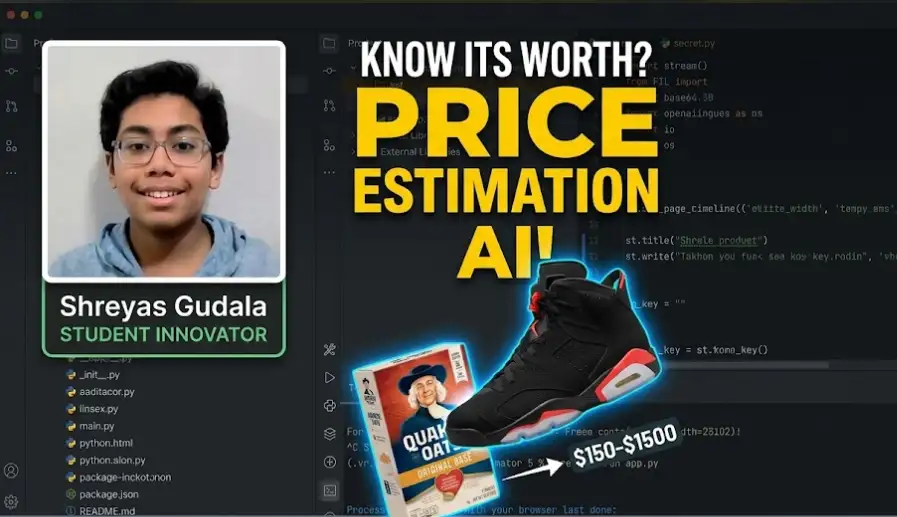
Shreyas Gudala, a 10th grade ForSyntax student, built a working AI application that lets you photograph any object and instantly receive an accurate description plus an estimated price range in US dollars. He built it with Python, Streamlit for the interface, Pillow for image handling, and OpenAI’s GPT-4o mini as the reasoning engine. It works on sneakers, water bottles, groceries, furniture, and almost anything else you point a camera at. He is fifteen years old.
Now the longer version, because how he got there is more useful to you than what he built.
The Problem He Chose to Solve
Most student coding projects are exercises. A calculator. A to-do list. A quiz game. Useful for learning, forgettable in a portfolio.
Shreyas started somewhere different. He started with a question that has a real answer attached to real money: what is this thing actually worth?
Anyone who has tried to resell an old pair of Air Jordans knows the problem. You open three marketplace apps, scroll through listings that may or may not match your item’s condition, guess a number, and hope. A student clearing out their room, a small business owner pricing secondhand stock, a renter deciding what to keep and what to sell, all of them face the same friction, over and over.
Shreyas decided the phone camera should just tell you.
What the App Actually Does
The workflow he designed is deliberately boring, and that is the highest compliment you can pay to a piece of software.
You open the app. You upload or capture a photo of an object. Within seconds you get back two things: a written description of what the object is, and an estimated price range in USD.
Point it at a pair of Air Jordans and it identifies the silhouette and returns a resale range. Point it at a water bottle and it recognises the type and returns a retail range. Point it at a box of Quaker Oats and it does the same. No dropdown menus. No category selection. No form filling. You show it a picture, it tells you a price.
That simplicity is not an accident. It is the hardest part of the build.
The Technical Stack, Explained For Parents
If you are a parent reading this and the words below mean nothing to you, that is completely fine. Here is what each piece does, in plain language.
Python is the programming language everything is written in. It is the language most professional AI engineers use, and it is the language ForSyntax students move into after Scratch. If you want to understand why we start children on Python rather than something more visual, our guide on what a child should build by the end of month one walks through the progression.
Streamlit is what turns Python code into something a normal person can actually use. Without it, Shreyas’s project would be a script that only a programmer could run. With it, the project became a real application with buttons, an upload area, and readable output. This is the difference between a school assignment and something you can send to your uncle and have him use it.
Pillow handles the images. When a user uploads a photo, Pillow processes it, resizes it, and formats it so the AI model can read it properly. Unglamorous work. Absolutely essential.
GPT-4o mini is the brain. It is a multimodal model, which means it can look at an image and reason about it in words. Shreyas fed it images and prompted it to return both an identification and a price estimate. Getting a model to return a useful price range rather than a vague guess is a prompting problem, not a coding problem, and it is exactly the skill we teach in our AI Prompting course.
Put together, this is computer vision plus multimodal language modelling wrapped in a clean interface. That sentence would look at home on a software engineer’s resume. It belongs to a fifteen year old.
Why This Project Matters More Than a Perfect Report Card
We want to be direct about something, because it is the reason we are writing this post at all.
A 10th grader who has shipped a working AI application has something that cannot be revised, coached, or repeated. A grade can be improved next term. A test can be retaken. A project that exists, runs, and solves a real problem is permanent evidence of capability.
Admissions officers see thousands of transcripts. They see very few applicants who can say: I identified a problem, chose a technical approach, integrated a commercial AI model, built a user interface, and shipped it.
The same applies to internships, to hackathons, to scholarship applications, and eventually to first jobs. Shreyas is fifteen. This project will still be on his portfolio when he is twenty two.
The Part Nobody Puts in the Highlight Reel
It did not work the first time. It did not work the fifth time.
The early versions returned descriptions that were technically correct and commercially useless. “A shoe.” Thank you. The price ranges were wildly wide, sometimes spanning several hundred dollars, which is not an estimate, it is a shrug.
The fixes were not glamorous. Better prompting to force the model to consider brand, condition, and market context. Image preprocessing so the model received consistent input. Constraints on the output format so results came back structured rather than as loose paragraphs. Testing against objects where he already knew the real price, so he could measure how wrong it was and narrow the gap.
This is the actual work of building with AI in 2026. Not the moment it works. The forty attempts before it works.
We say this openly because we think parents deserve an honest picture of what our sessions look like. If you want more on how live instruction handles this kind of iterative struggle differently from a pre-recorded video course, our honest comparison of live versus recorded classes covers it in detail.
How a Student Gets From Zero to This
Parents ask us a version of this question every week: my child has never coded, is this realistic for them?
Yes, and here is the honest sequence.
Stage one, foundations. Understanding variables, loops, functions, and logic. For younger learners this happens visually through Scratch block coding. For teenagers starting fresh, we usually go straight to Python, because teenagers find visual blocks patronising and disengage.
Stage two, building things that run. Small programs with real output. A script that does something. This is where confidence forms, because the student stops learning about code and starts using it.
Stage three, interfaces. Making things other people can use. This is where Streamlit, or web development, or app development enters. The shift from “my code works” to “someone else can use my code” is the single biggest jump in a young builder’s confidence.
Stage four, AI integration. Working with real models, real APIs, real constraints. This is our Python AI and ML course, and it is where Shreyas was working when he built this.
There is no shortcut through stage one and two. There is also no reason a motivated teenager cannot move through all four in a year of consistent weekly sessions.
What We Did Not Do
We did not give Shreyas this project. We did not hand him a template, a tutorial, or a finished repository to modify.
His mentor’s job was different: ask the right question at the right moment, point out when an approach was going to hit a wall, and refuse to write the code for him when he was stuck. That last part is harder than it sounds, and it is the reason we run live one to one sessions rather than recorded content. A video cannot tell the difference between a student who needs a hint and a student who needs to be left alone for another ten minutes.
Every ForSyntax mentor works this way, whether the student is a fifteen year old building AI applications or a seven year old building their first Scratch animation. It is also the approach behind ForSyntax Inclusive, our dedicated wing for children with autism, ADHD, dyslexia, and other learning differences, where the same educator stays with the same student every single session.
Demo Presentation:
Five Project Ideas in the Same Family
If your teenager finds this interesting, these are all achievable with the same stack, and each one solves a real problem.
A plant health checker. Photograph a leaf, get a diagnosis and a care recommendation.
A homework helper that reads handwriting. Photograph a maths problem, get a step by step explanation rather than just an answer.
A wardrobe cataloguer. Photograph clothes, build a searchable inventory with automatic categorisation.
A grocery expiry tracker. Photograph a receipt, extract items, estimate shelf life, send reminders.
A study notes summariser. Photograph pages from a textbook, get structured revision notes.
Every one of these uses image input plus a multimodal model plus a simple interface. Every one of them is a genuinely portfolio worthy project. None of them requires a computer science degree to begin.
What This Says About Screen Time
We will end where a lot of parents actually start.
Most conversations about children and screens are about restriction. How many hours. Which apps. What to block.
Shreyas spent a significant number of hours in front of a screen to build this. Nobody in his family is worried about it, because the output is an application that works and a skill set that compounds.
The question is not how long a child is looking at a screen. The question is whether they are consuming or creating. We wrote about this in more depth in why screen time is not the problem, creation time is, and it remains the single most useful reframe we can offer parents.
Frequently Asked Questions
What exactly did the ForSyntax student build?
Shreyas Gudala, a 10th grade ForSyntax student, built a price estimating AI application. A user uploads or captures a photograph of any object and the app returns a written description of the item plus an estimated price range in US dollars. It was built with Python, Streamlit for the user interface, Pillow for image processing, and OpenAI’s GPT-4o mini as the multimodal reasoning model.
How old do you need to be to build something like this?
Shreyas is fifteen. In our experience the realistic starting point for AI application projects is around thirteen, because the work requires sustained debugging and abstract reasoning. Younger children absolutely can and do work with AI concepts, but through more guided and visual projects. Children as young as seven start with us through Scratch and progress from there.
Does my child need to already know how to code?
No. Students join ForSyntax at every level, including complete beginners. A motivated teenager with no prior experience typically needs eight to twelve months of consistent weekly sessions to reach the point where AI application projects like this become achievable. The sequence is foundations, then programs that run, then user interfaces, then AI integration.
What is GPT-4o mini and is it safe for students to use?
GPT-4o mini is a multimodal AI model from OpenAI, meaning it can process both images and text. It is a commercial production tool used by real software companies. Students access it through an API key under mentor supervision, and our sessions cover responsible use, cost awareness, and the limitations of AI outputs as part of the curriculum.
Is this the kind of project that helps with college applications?
It is one of the strongest signals a student can have. A completed, working application demonstrates initiative, technical capability, and follow through in a way that grades alone cannot. Our Premium plan includes career and college portfolio coaching specifically for students building towards applications.
Can my child do this if they learn differently?
Yes. ForSyntax Inclusive is our dedicated wing for children with autism, ADHD, dyslexia, and other learning differences. Many neurodiverse students find coding particularly well suited to how they think, because the rules are consistent, the feedback is immediate, and the output is visual. You can read about our approach in our post on teaching a student with autism to code.
How much does it cost and how do we start?
Plans start at 69 dollars per month for one live one to one session per week, with small group options from 39 dollars per month. Every family starts with a free 60 minute trial session with a real mentor. No card is required and there is no follow up sales call if it is not the right fit.
Which course should my teenager join to build something like this?
If they have no coding background, start with Python for Kids and Teens. If they already code and want to move directly into AI, start with Python AI and ML. If they are most interested in the AI reasoning side rather than the engineering side, AI Prompting is the better entry point. On the free trial call, our team will recommend the right starting point based on your child’s actual level.
Ready to See What Your Child Builds?
Shreyas started as a student who had not built an AI application before. Every ForSyntax student does.
Book a free 60 minute live session with a real mentor. Your child works on something real in that first session. If they love it, choose a plan. If they do not, there is no follow up call and no pitch.
Or browse all ForSyntax courses, see our plans and pricing, or get in touch with our team if you would like to talk it through first.
