
Robotics vs Coding for Kids: Which One Should Your Child Learn First?
Most parents come to this question the same way. Their child spends two hours building something in Minecraft. Or they take apart a remote-control car and…
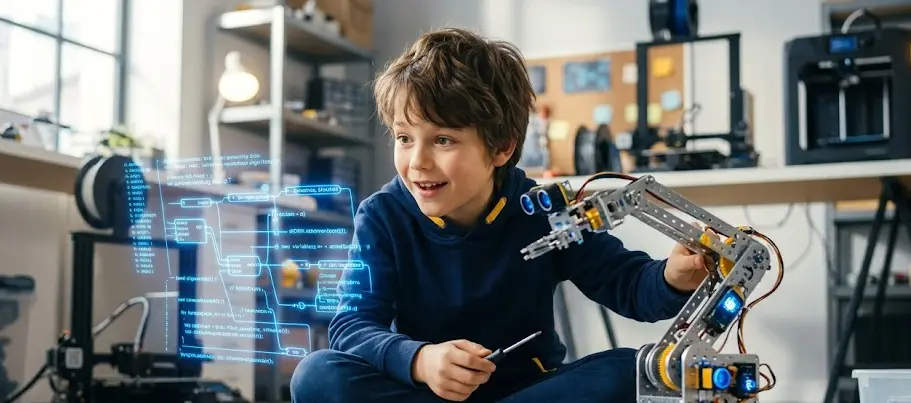
Most parents come to this question the same way.
Their child spends two hours building something in Minecraft. Or they take apart a remote-control car and actually put it back together. Or they ask, completely unprompted, how a traffic light knows when to change colour.
And the parent thinks: this child needs something more. Something that channels this.
Then the search begins. Coding classes show up. Robotics kits show up. Coding bootcamps for kids, robotics clubs, STEM courses, live sessions, recorded sessions, Scratch, Python, Arduino, LEGO Mindstorms. The list grows and the clarity shrinks.
This post exists to cut through that entirely.
Not with a ranking or a top-10 list. With the actual difference between what robotics and coding do to a child’s brain, what each one builds in a 9 to 14 year old specifically, and which one to start with based on your child’s actual personality rather than a generic age recommendation.
One disclosure upfront: we run ForSyntax, a live 1:1 online coding and robotics programme for children. We have taught hundreds of children both subjects. Everything in this post comes from watching real children learn both. We are going to tell you things that do not always push you toward enrolling with us, because the right answer for your child matters more than the sale.
What Most People Get Wrong About This Question
The internet mostly frames this as a competition. Robotics versus coding. Which is better. Which is the future. Which will get your child a job in 20 years.
That framing misses the entire point.
Robotics and coding are not two separate career tracks that a child must choose between at age nine. They are two different entry points into the same world. One is physical first and logical second. The other is logical first and applied second. Both lead to the same destination. The question is only which door suits your child better right now, at this stage of their development.
Understanding that changes the whole conversation.
What Coding Actually Is, Without the Jargon
Coding is the act of writing instructions that a computer follows. That is the entire definition.
When a child aged 9 sits down in a live coding session and starts writing a quiz game in Scratch, they are telling the computer: if the player clicks the right answer, play this sound and add one to the score. If the player clicks the wrong answer, show this message and try again.
Every line of code is an instruction. Every project is a system of instructions working together.
What this builds in a child is not primarily a technical skill. It is a thinking pattern. Coding forces a child to break a problem into tiny steps, predict what happens at each step, test whether their prediction was right, and fix it when it was not. This loop, repeated hundreds of times across a coding journey, becomes a habit of mind.
Children who code do not just learn to programme. They learn to think in sequences. They learn that complexity is just many simple steps chained together. They learn that failure is just information that tells you where the instruction broke down.
These are not coding skills. They are thinking skills that happen to be taught through coding.
What Robotics Actually Is, Without the Jargon
Robotics is the practice of building physical systems that move, respond, and act in the real world.
When a child aged 10 sits down in a robotics session, they are not just snapping plastic pieces together. They are making a mechanical decision with every joint, every sensor, every motor. Where does the sensor go? Why there and not somewhere else? What happens if the robot hits a wall? How does it know to turn?
And then, crucially, they write the code that makes it do all of that.
This is the part that surprises most parents. Robotics is not the alternative to coding. Robotics is one of the most demanding applications of coding. A child doing robotics is doing everything a child doing coding is doing, plus managing the physical constraints of a mechanical system that exists in the real world and behaves unpredictably.
A bug in a coding project shows up on a screen. A bug in a robotics project shows up when the robot drives off the table.
What this builds in a child is different from pure coding in one important way: it makes the abstract concrete immediately. A child who has trouble believing that their code does anything real will believe it the moment a robot arm they built lifts a cup.
The Real Difference That Nobody Talks About
Here is what years of teaching both subjects to children aged 9 and above has shown us, and you will not find this framed this way anywhere else.
Coding is primarily a discipline of precision. Robotics is primarily a discipline of iteration.
In coding, the instructions must be exactly right. A misplaced bracket breaks everything. A wrong variable name breaks everything. The computer does exactly what you tell it to do, which means your instructions must be exactly what you mean. Children who thrive in coding early tend to have a natural instinct for precision. They re-read their instructions. They notice when something is slightly off. They are bothered by small errors.
In robotics, nothing works exactly right the first time. The physical world introduces friction, weight, battery levels, surface texture, sensor drift. A robot that navigates a test track perfectly in the morning fails the same track in the afternoon because the light changed and the sensor reads differently. Children who thrive in robotics early tend to have a natural instinct for iteration. They expect failure. They are not bothered by it. They want to know why it failed and try again.
These are not better or worse traits. They are different traits. And identifying which one your child has is more useful than any age-based recommendation.
Which Type of Child Starts With Coding
Start with coding if your child:
Loves storytelling and games with rules. Coding is fundamentally about creating systems with rules. A child who designs elaborate Minecraft worlds with their own logic, who invents board games and insists everyone follows the rules exactly, who has a favourite book series they can explain in perfect plot sequence, is already thinking like a coder.
Is careful and methodical. If your child reads instructions before starting a task (even if other children skip them), if they get genuinely bothered when something does not match its description, if they notice continuity errors in films, coding will feel intuitive rather than frustrating.
Prefers to understand before acting. Coding rewards children who want to understand what they are building before they build it. A child who asks why before they ask how will adapt to the coding mindset faster than a child who just wants to start building.
Has a specific project in their head. The most motivated young coders we have taught are children who came to us with a specific thing they want to make. Not a vague interest in technology. A specific thing. A quiz about their favourite sport. A calculator for their maths homework. A game where the character jumps over obstacles. Specificity of project idea is the single strongest predictor of early motivation in coding.
Which Type of Child Starts With Robotics
Start with robotics if your child:
Learns by touching. Some children understand a concept when they read about it. Other children understand a concept when they hold it, move it, break it, and put it back together. If your child has consistently learned better through doing than through watching or reading, the immediate physical feedback of robotics will accelerate their progress significantly compared to the abstract feedback of a coding screen.
Is motivated by visible results. Coding produces outputs on a screen. For most children, this is satisfying. For some children, a screen output does not feel real enough to stay motivated. If your child needs to show something to someone, needs to point and say look what I made, robotics provides that in a way coding takes longer to build to.
Has high frustration tolerance but low boredom tolerance. This is a specific combination we see often in robotics-first children. They handle failure without significant distress because they find the debugging process interesting. But they disengage fast when nothing is happening. Robotics is never nothing happening. Even a failing robot is doing something.
Already takes things apart. This is not a metaphor. Children who disassemble things out of curiosity, who want to know what is inside a toy car or a broken headphone, who have removed the back of something just to see what is there, have an instinct for mechanical systems that makes robotics immediately engaging rather than intimidating.
The Overlap Nobody Explains
Here is what the robotics versus coding debate ignores entirely: at age 9 and above, the two subjects share so much foundational thinking that starting with either one builds the same underlying competency.
A child who spends six months learning to code in Scratch and Python is learning logic, sequence, variables, conditional thinking, and debugging. A child who spends six months in robotics is learning the same logic and sequence through the additional lens of physical systems. When the coding child moves into robotics, they already have the thinking pattern. They just need to apply it to a physical context. When the robotics child moves into pure coding, they already have the iteration instinct. They just need to apply it without the physical feedback loop.
The skills transfer almost perfectly in both directions. This means the first choice is not a commitment to a path. It is a choice of starting point, determined by what will keep your individual child engaged enough to build the foundational thinking in the first place.
A child who starts robotics because they are physical learners and stays engaged for a year has built more coding thinking than a child who starts coding, disengages in month two because it does not feel real enough, and stops. Engagement is the prerequisite for every other outcome. Subject choice serves engagement, not the other way around.
What Age 9 Specifically Changes About This Decision
Before age 9, the coding versus robotics decision is almost entirely determined by fine motor development and attention span. Robotics with physical components requires a level of manual dexterity and sustained focus that develops unevenly before age 9. Most 7-year-olds do better starting with visual block coding in Scratch, regardless of their personality type.
Age 9 changes this. By 9, the majority of children have the fine motor control to work with robotic components without the session becoming a frustration exercise. They have the working memory to hold a multi-step project plan in mind while executing step one. They have enough self-awareness to know whether they are stuck because they do not understand something or because they made a mechanical error. They can distinguish between those two failure types, which is actually a sophisticated metacognitive skill.
Age 9 is also when the motivational differences between types of learners become reliably visible. A child who has been in school for several years now has a track record. You know whether they re-read their work or submit it first-draft. You know whether they get frustrated when things break or interested. You know whether they build with LEGO by following the instructions exactly or by inventing their own structures. These observations are better inputs to the robotics versus coding decision than any age chart.
The Question of Career and Future Relevance
This comes up in every parent conversation. Which one will matter more when my child is 20?
The honest answer is that neither robotics nor coding as a subject is what will matter. The thinking pattern it builds is what will matter.
Children who learn to code in 2026 are not necessarily learning to write code professionally in 2036. The specific languages they learn now will evolve. The tools will change. What does not change is the habit of breaking problems into logical steps, writing precise instructions, testing outputs, and fixing failures methodically. That thinking pattern applies to engineering, medicine, finance, design, law, and every other professional domain where problems need to be solved systematically.
Children who learn robotics are not necessarily building robots professionally in 2036. They are developing the ability to work with physical systems, to anticipate real-world unpredictability, to iterate under constraints. That applies to manufacturing, product design, architecture, urban planning, and surgical medicine.
The career question is better framed as: which discipline will keep my child engaged long enough to build the thinking pattern deeply? Because depth of engagement over time is what produces genuine competency, not the subject name on the course.
What Happens When You Do Both
The most capable young learners we have worked with at ForSyntax are not exclusively coders or exclusively robotics students. They are children who started with one and naturally moved into the other after building sufficient confidence in the first.
A child who spends four months building projects in Python, genuinely understanding variables, loops, and conditional logic, and then picks up a robotics kit does something remarkable in their first session. They immediately start thinking about the robot’s behaviour as a function. If the sensor reads less than 30, turn left. If more than 70, turn right. Otherwise, go straight. They write that logic in five minutes because they already think that way. The robot is just a new output device for thinking they have already developed.
A child who spends four months building and programming physical robots, dealing with real-world unpredictability, developing genuine iteration instinct, and then moves into software development does something equally interesting. They are not intimidated by a bug. They have debugged a robot that drives into walls. A variable that holds the wrong value is a simpler problem than a sensor that reads wrong because the battery is at 60 percent. They bring a calmness to software debugging that purely coding-first children often take longer to develop.
The sequence matters less than the depth. Four deep months in one subject, genuinely building projects and solving real problems, is worth more than a year of surface-level exposure to both simultaneously.
How Live 1:1 Sessions Change the Starting Point Decision
There is one more variable that the robotics versus coding debate almost never addresses: how the subject is taught changes what a child gets from it.
A child learning coding through a recorded course and a child learning coding through a live 1:1 session with a real teacher are having fundamentally different experiences, regardless of the content.
In a recorded course, the child follows a pre-determined path. They get stuck and have two options: replay the video or give up. There is no teacher to notice that the child is using the right syntax but misunderstanding the concept. There is no one to ask a question that shifts the child’s understanding in the right direction. There is no relationship that makes the child come back next week even when the session was hard.
In a live 1:1 session, the teacher sees the child’s screen, hears their reasoning, and can identify whether a mistake is a typing error or a conceptual misunderstanding. These are completely different problems requiring completely different responses. A typing error needs correction. A conceptual misunderstanding needs a different explanation, often one that connects to something the specific child already understands. A live teacher can do that. A recording cannot.
This matters for the robotics versus coding decision because live 1:1 teaching compresses the timeline on both subjects. A child who might take six months to build genuine confidence in coding through self-paced materials reaches the same level in three months with a live teacher who adjusts the pace and explanation style to exactly that child. This means the first subject choice has lower stakes than it appears, because the time to competency in the first subject is shorter, and the move to the second subject happens sooner.
At ForSyntax, we have watched children who were convinced they would never understand abstract coding concepts achieve real comprehension in four to six weeks of live 1:1 sessions. Not because our teachers are exceptional (though we believe they are). Because live teaching is a fundamentally different mode that responds to the individual child rather than the average child.
A Framework for Making the Decision
Stop searching for the objectively better subject. There is no answer to that question that applies to your child specifically. Use this framework instead.
Sit with your child for fifteen minutes and observe them with a building task. Give them something physical to assemble with several steps. It does not need to be a robotics kit. A piece of flat-pack furniture works. A LEGO set works. Watch how they approach it. Do they read the instructions first? Do they start building and check instructions when stuck? Do they ignore the instructions entirely and try their own approach? Do they get frustrated when a step does not work as expected, or more interested?
If they read first and followed methodically: coding first.
If they started building and adapted as they went: robotics first.
If they ignored the instructions entirely and built something different: robotics first, but expect them to need a teacher who can channel that creative instinct rather than fight it.
If they got frustrated and stopped: start with coding on a topic they already care about. The subject interest overrides the learning style when motivation is low.
This is not a clinical assessment. It is 15 minutes of observation that tells you more about how your child builds than any age chart or subject ranking ever will.
Frequently Asked Questions
My child loves gaming. Does that mean they should start with coding?
Not automatically, but it is a reasonable indicator. Children who love playing games often have an intuitive understanding of rules, conditions, and outcomes. When you explain that coding is how games are built, children with gaming backgrounds often feel an immediate sense of purpose. They are not learning an abstract skill. They are learning how the things they love are made. That said, if your child loves gaming because of the social experience or the visual spectacle rather than the mechanics and rules, the gaming connection is less predictive. Ask your child what they find interesting about the specific games they play. If the answer involves rules, logic, or how things work, start with coding. If the answer is about the story or the characters, either subject works equally well as a starting point.
Can a 9-year-old genuinely build something in robotics, or is it just playing with pieces?
A 9-year-old with live instruction and appropriate equipment can build a robot that navigates a simple obstacle course, responds to sound or light sensors, follows a line on the ground, or performs a repeatable mechanical sequence, within their first three months. These are not toy outcomes. They are real engineering products that require the child to understand mechanical assembly, sensor input, logic conditions, and iterative debugging. The perception that robotics for children is just playing with pieces comes from poorly designed programmes that do not give children enough scaffolded challenge. In a well-run live session, a 9-year-old surprises themselves regularly.
My child’s school already teaches basic coding. Should we do more coding or switch to robotics?
Almost certainly switch to robotics, or deepen the coding beyond what school offers. What most schools teach as coding is visual block programming at an introductory level. This is valuable as a foundation but rarely goes deep enough to build genuine computational thinking. If your child has done Scratch at school and found it straightforward, they are ready to go deeper into Python, game development, or robotics. Repeating the same foundational content at a different provider wastes the child’s time and often creates the impression that coding is less challenging or interesting than it actually is when done properly.
Is robotics significantly more expensive than coding for parents?
Online coding requires a device and an internet connection. Online robotics requires those plus a physical kit. The kit cost varies between Rs 3,000 and Rs 15,000 depending on the complexity, and it is a one-time cost rather than a recurring one. A good starter robotics kit lasts 2 to 3 years of learning before a child outgrows it. Spread over 3 years, the additional cost of a Rs 8,000 kit is approximately Rs 220 per month. For most families who are already investing in educational enrichment, this is not a significant additional cost. If budget is a constraint, starting with coding and moving to robotics after 6 months is a completely reasonable phased approach.
Will AI replace the need for my child to learn coding or robotics?
This question comes up in every parent conversation and the honest answer is more nuanced than either the pessimistic or optimistic version you will read online. AI tools in 2026 are excellent at generating code when given a clear description of what is needed. They are poor at understanding why a particular approach is better than another, debugging unexpected behaviour in complex systems, and making design decisions that require understanding human context. The children who will work effectively alongside AI tools in 2036 are not the children who know the most syntax. They are the children who understand what they are asking the AI to do and can evaluate whether the AI’s output is correct, efficient, and appropriate. That requires knowing how code and physical systems actually work. Coding and robotics build that understanding. They remain relevant precisely because AI makes the surface-level skills less important and the deep conceptual understanding more important.
How many hours per week does a child actually need to make meaningful progress?
In a live 1:1 setting, two sessions of 45 to 60 minutes per week produces visible, meaningful project progress within four weeks. This surprises parents who assume technology education requires daily engagement like a language. It does not. The reason is that live 1:1 teaching is extremely high-density learning. Every minute of a live session is focused on the specific child’s current understanding. There is no time spent waiting for others, no time spent on content the child already knows, no time lost to the teacher explaining something in a way that does not land. Two sessions per week of this quality consistently outperforms five sessions per week of self-paced content, based on what we have observed across hundreds of students.
My child started coding, lost interest in month two, and stopped. Should I try robotics instead?
Yes, with an important qualification. Before attributing the loss of interest to the subject, identify whether the disengagement was from coding specifically or from the delivery format. If the child was following recorded tutorials and stopped when they got stuck, the issue is almost certainly the format rather than the subject. Recorded content cannot respond to a stuck child. A live teacher can. We have re-engaged children who had previously disengaged from coding within three weeks of switching to live 1:1 sessions on the same subject. If the child tried live sessions and still disengaged, robotics is a strong next step, particularly if they show any of the physical learner traits described earlier in this post.
The Simplest Version of This Guide
If your child thinks before they build, start with coding.
If your child builds before they think, start with robotics.
If you are unsure, book a free live trial session with a real teacher and watch what happens in 45 minutes. A good teacher will identify within one session which approach suits your child and tell you honestly.
At ForSyntax, that is exactly what we do in our free trial. No commitment, no sales pitch inside the session. A live educator, your child, and 45 minutes of genuine teaching. What your child builds, how they respond to being stuck, how they react when something works, tells us everything we need to know about where to start.
