
Transforming Screen Hours: From Passive Watching to Active Learning
My daughter’s teacher sent home a note last week. It said she was distracted in class, always thinking about “that game.” The teacher assumed it was…
My daughter’s teacher sent home a note last week. It said she was distracted in class, always thinking about “that game.” The teacher assumed it was a problem. What the teacher did not know was that my daughter was not playing the game. She was building one.
We have spent the last decade fighting the wrong battle. Parents, schools, paediatricians. All of us have been measuring the wrong number. We count the hours. We set timers. We argue at the dinner table about putting the phone down. And the entire time, the more important question has been sitting right in front of us, unanswered.
Not how long. What for.
The Number We Are All Watching Is the Wrong Number
Open any parenting forum today. Reddit, Facebook groups, WhatsApp communities. Within five minutes you will find a panicked post that follows the same script. My child is on screens for four hours a day. Is that too much? What should I do?
The responses pour in. Limit to two hours. Take it away on weekdays. No screens before homework. Screen-free Sundays.
Everyone is answering the question of duration. Nobody is asking the question of direction.
Here is the thing the research actually shows. The American Academy of Pediatrics, the organisation parents most often cite when arguing about screen limits, quietly shifted its position in 2023. It moved away from hard hourly limits and toward a more nuanced framework. The question they began asking was not how much screen time a child is getting. It was whether the screen time is interactive or passive, creative or consumptive, social or isolating.
Duration alone, the research concluded, is not the right metric.
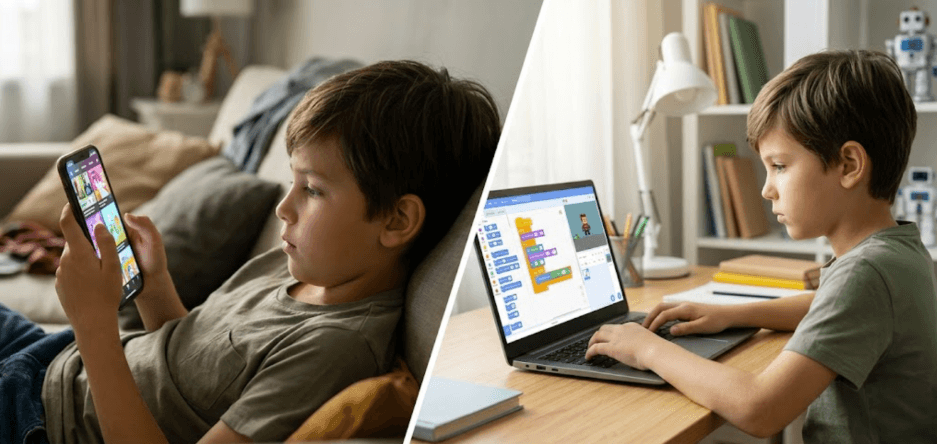
A child watching the same Online video on repeat for three hours is doing something fundamentally different from a child spending three hours building a game in Scratch or designing a robot’s movement sequence. The screen is the same object. The experience happening inside the child’s brain is not remotely comparable.
Two Children, One Hour, Completely Different Outcomes
Imagine two children. Both ten years old. Both sitting in front of a screen for sixty minutes on a Tuesday evening.
Child A is watching gaming videos. Reacting, laughing, occasionally commenting. Passively receiving a stream of content someone else created for the purpose of holding attention as long as possible. When the sixty minutes end, the child has been entertained. Nothing has been made. No skill has been practised. The algorithm offers the next video immediately.
Child B is in a live coding session. Working with a teacher in real time. Building a quiz game about their favourite subject. Space. They have hit a bug in their code three times this session. Three times they have stopped, thought about the logic, tried something different. When the sixty minutes end, the game exists. It works. The child built it. They can show it to their parents tonight and explain every decision they made.
Both children spent one hour on a screen.
One hour of consumption. One hour of creation.
If you were designing the childhood you want for your child, which hour would you choose?
What Creation Time Actually Does to a Child’s Brain
This is not motivational language. There is specific, documented cognitive development happening when a child creates rather than consumes on a screen.
When a child builds something. A game, a programme, a robot’s movement sequence, an AI model that recognises their drawings. They are practising what researchers call computational thinking. Breaking a big problem into smaller parts. Spotting patterns. Building logical sequences. Testing, failing, adjusting, trying again.
These are not coding skills. They are thinking skills. And they transfer directly.
A 2024 study from the University of Edinburgh found that children who engage in structured creative computing activities demonstrate measurably stronger performance in mathematics, reading comprehension, and problem solving tasks compared to peers with equivalent screen time spent on passive consumption. The difference was not small. It was significant enough that the researchers recommended creative computing be treated as a core cognitive development activity, not an enrichment add-on.
The key word in that finding is structured. Not free-form play on any creative app. Structured creative computing. Where a child is working toward a goal, receiving feedback, iterating on their work, and producing an output they can evaluate. This is precisely what a live 1:1 coding session provides that no app, no Online tutorial, and no self-paced course can replicate. A real teacher who sees where the child’s thinking breaks down and adjusts the session in real time.
The Consumption Trap Is Designed by Professionals
Here is something worth sitting with for a moment.
The products consuming your child’s screen time were designed by some of the most talented engineers, psychologists, and behavioural scientists on the planet. Their singular professional objective is to keep your child watching for as long as possible. Autoplay, recommendation algorithms, variable reward loops. These are not accidents of design. They are the product. Your child’s attention is the inventory being sold to advertisers.
Nobody designed that system for your child’s benefit.
The coding class, the robotics session, the game development project. These were designed with the opposite objective. The measure of success is not how long your child stays engaged with a platform. It is what your child can do at the end that they could not do at the beginning.
One system extracts from your child. The other builds in them.
Understanding this distinction changes how you look at screen time entirely. The problem was never the screen. The problem was whose agenda was being served during those hours.
What We See in ForSyntax Sessions Every Week
I want to be specific here because specific is more useful than general.
Every week, across ForSyntax’s live 1:1 sessions, we work with children aged 6 to 16 across India, UAE, and the UK. These are children whose parents came to us worried about exactly the thing you are worried about. Too much gaming. Too much Online. Not enough focus. Not enough to show for all those hours on the screen.
What happens in a typical first month is not dramatic. It does not look like a transformation. It looks like a child who is slightly more curious on Wednesday than they were on Tuesday. A child who, when their game bugs out, does not get frustrated and quit. They get interested. When did that start happening? Let me think. What changed in the code?
That instinct. To treat failure as information rather than defeat. Is not a coding skill. It is a life skill. And it develops specifically in the context of building something real, with a teacher who knows how to let the child struggle productively without letting them drown in confusion.
One of our parents in Kerala told us something that stayed with me. She said her son used to come home from school, pick up his tablet, and disappear for three hours. She felt guilty about it but did not know how to fight it. After two months with ForSyntax, she said he still picks up the tablet immediately after school. But now he is building something on it. And he talks to her about what he is building at dinner. The tablet had not changed. What he was doing on it had changed completely.
That is the shift. Not fewer hours. Different hours.
The Practical Question Every Parent Is Actually Asking
You are reading this and thinking one of two things. Either this resonates and you want to know what to do next. Or you are sceptical and you want to know if this is just marketing for a coding class.
It is both, and I would rather be honest about that than pretend otherwise. Yes, ForSyntax offers live 1:1 coding sessions for children. Yes, I believe they are genuinely valuable. I also believe that the argument I have made in this post stands independently of whether your child ever takes a ForSyntax class.
The practical answer to “what do I do about my child’s screen time” is not to count the hours more carefully. It is to introduce at least one hour per week of structured creative computing into what those hours contain. That could be ForSyntax. It could be another live coding provider. It could be a robotics club at school or a game design workshop in the community.
The format matters less than the principle. Creation over consumption. Building over watching. Making something that did not exist before.
If your child spends five hours a week on screens and one of those hours is a live coding session where they build a real project with a real teacher, the other four hours become significantly less concerning. Because you have established that screens can be tools of creation, not just channels of consumption. And children, once they experience what it feels like to build something, start to see screens differently on their own.
Book a Free Trial Session
ForSyntax offers live 1:1 coding sessions for children aged 6 to 16 across Coding, Gen AI, Robotics, Game Development, Math, and AI Automation. Every child builds a real project in their very first session. No recordings. A real teacher. Your child creates something in 60 minutes.
Book a free trial session at ForSyntax.com. No commitment. No pitch. Just your child building something they are proud of.
Frequently Asked Questions
My child has no interest in coding. Will this still work for them?
Most children who say they have no interest in coding have never built anything with code. They imagine it as typing confusing symbols into a black screen. The first session almost always changes that. We start with what the child loves. Games, animals, space, sport. And build something connected to that interest. Coding becomes the means to an end they already care about, not a subject they are being asked to study.
How is a live session different from a coding app my child already has?
A coding app gives your child puzzles to solve. A live session gives your child a teacher who sees exactly where their thinking breaks down and adjusts in real time. The difference is diagnostic. When your child gets stuck, an app gives a generic hint. A human teacher asks one specific question that unlocks the block. That diagnostic ability is why live sessions produce results in 20 hours that apps cannot produce in 60 hours.
My child already watches coding tutorials on Online. Is that not enough?
Watching someone else code is the equivalent of watching someone else exercise. The information goes in but the skill does not develop. Coding is a doing skill. The neural pathways that make a child a capable, confident coder are built through attempting, failing, adjusting, and succeeding. Not through watching. Online tutorials are a useful supplement once a child already has a foundation. They are not a substitute for structured practice with feedback.
What age isthe right age to start?
Six years old is our starting point and sixteen is not too late. The right age is whenever your child shows curiosity about how things work. Games, apps, toys, machines. That curiosity is the signal. We adjust our curriculum and tools completely by age. A six-year-old works in Scratch with visual blocks and builds animated stories. A fourteen-year-old is writing Python and designing functional applications. The starting point is different. The principle is the same. The child creates something real from the first session.
Is screen time during a coding session different from other screen time?
Yes, meaningfully so. A live coding session involves real-time communication with a teacher, active problem solving, iterative creation, and a tangible output at the end. The brain during a coding session is in a fundamentally different mode from the brain during passive viewing. If you want a simple heuristic: does the session end with something your child made? If yes, it is creation time. If no, it is consumption time. Creation time is what we are arguing for. Consumption time is what we are all trying to reduce.
We are based in UAE or the UK. Does ForSyntax work for us?
Yes. All ForSyntax sessions are live and online. We currently work with families in India, UAE, and the UK. Session timing is flexible and accommodates Gulf and UK time zones. We also have a dedicated inclusive programme for neurodiverse learners that has seen particularly strong outcomes with children on the autism spectrum.
How do I know if my child is making real progress?
You can see it. At the end of every ForSyntax session, your child has built or progressed something specific. At the end of month one, they have a completed project. A working game, a functioning programme, a robot that moves the way they designed it to move. Progress in ForSyntax is not measured by quizzes or certificates. It is measured by what exists at the end of the session that did not exist at the beginning. Parents report that this visibility of progress is what makes ForSyntax feel different from every other class their child attends.
