
What Is Project Based Learning? A Parent’s Guide to Learning by Building
Project based learning is a teaching method where a child learns a subject by building something real with it, instead of learning the theory first and…
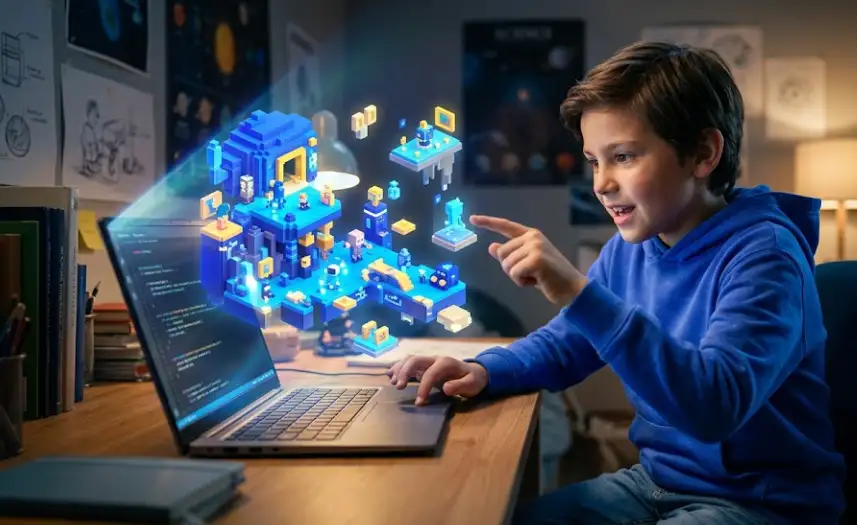
Project based learning is a teaching method where a child learns a subject by building something real with it, instead of learning the theory first and applying it later. In coding, this means a child learns loops, variables and functions while building a working game, not before it. The project is not the reward at the end. The project is the lesson itself.
That is the definition. Now let us talk about why it matters more than almost any other choice you will make about your child’s learning this year.
The Problem Every Parent Has Already Noticed
Your child studied for a test. They scored well. Three weeks later, they cannot explain the topic to you.
This is not a memory problem. It is a storage problem. Information that arrives as instruction and leaves as an answer sheet never gets filed anywhere useful in the brain. It goes in as text and comes out as text, and nothing in between required the child to actually use it.
Now compare that with something your child learned by doing. Riding a cycle. Playing a game. Cooking something with you. Ask them about it two years later and they still know. Nobody handed them a worksheet on balance. They wobbled, fell, adjusted, and their brain built a permanent file.
Project based learning takes that second mechanism and applies it deliberately to academic subjects. In coding, it is the difference between a child being told what a loop is, and a child needing a loop right now because their game character will not move without one.
Project Based Learning, Defined Properly
Project based learning, often shortened to PBL, is an instructional method where students gain knowledge and skills by working for an extended period on a complex question, problem or challenge, and by producing a real, public product at the end of it.
Three parts of that definition matter enormously, and most classes that claim to do PBL only manage one of them.
Extended period. A real project takes weeks, not a single session. The child hits problems, gets stuck, comes back to it, changes their mind about a feature, and finishes something they were not sure they could finish. That arc is where the learning lives. A one hour “make a project” activity is a craft session, not project based learning.
Complex and open ended. There has to be more than one right answer. If every child in the class produces the identical output, the children were following instructions, not solving a problem. Real PBL means two children given the same brief produce two genuinely different things.
Real, public product. The child ends up with something they can show. A game a friend can play. An app that runs on a phone. A website with their name on it. The moment a child shows a parent something they made, the learning locks in permanently, because now it is tied to identity and not just to memory.
If a course does all three, it is project based. If it does one, it is a normal course with a project stapled to the end.
What Project Based Learning Looks Like in a Real Coding Class
Here is the difference in practice.
Traditional approach:
Week 1, the child learns what a variable is. Week 2, loops. Week 3, conditionals. Week 4, functions. Week 8, they are told to build a small project using all of it. By week 8 the child has forgotten week 1 and has spent seven weeks with no idea why any of this mattered.
Project based approach:
Session 1, the child says they want to build a snake game. The mentor says fine, let us start. To make the snake move, we need a variable to store its position. Now the child learns variables, but they learn them because the snake will not move without them. To make the snake keep moving, we need a loop. To make it die when it hits the wall, we need a conditional. To add power ups, we need functions.
Same concepts. Same sequence, more or less. Completely different retention, because every single concept arrived at the exact moment the child needed it to solve a problem they personally cared about.
This is exactly how our sessions are structured. One of our students, Aanya, age 11, built a retro snake game with custom power ups and levels in Python and Pygame. It came to about 240 lines of code across six weeks. She did not sit through six weeks of Python theory and then build a game. She built a game and picked up Python on the way. Her learning path looked like this: variables, then loops, then functions, then shipped.
Why It Works: The Four Mechanisms
Project based learning is not a trend or a marketing phrase. It works because of four specific things happening in a child’s brain, and it is worth understanding each of them so you can spot the real thing when you see it.
1. Concepts arrive with a reason attached
The human brain is extremely good at discarding information that has no immediate use. This is a feature, not a bug. Without it, we would be paralysed by trivia.
When a child is taught a concept in isolation, their brain correctly categorises it as low priority and clears it out. When the same concept arrives attached to an immediate need, the brain files it as useful and keeps it. The concept is identical. The context is what determines whether it survives.
2. Failure becomes information instead of judgement
In a test based system, being wrong is a penalty. In a project based system, being wrong is just the next clue. The code does not run, so something needs fixing. There is no mark being deducted. There is no comparison to a classmate. There is only a problem and a child working on it.
This is genuinely transformative for children who have learned to be anxious about getting things wrong. We see this most powerfully in ForSyntax Inclusive, our wing for children with autism, ADHD, dyslexia and other learning differences. Coding gives immediate, neutral, non emotional feedback. The computer does not sigh. It does not look disappointed. It just does exactly what it was told, and the child adjusts. For a child who has spent years feeling watched and judged in a classroom, that neutrality is a genuine relief. We wrote about this in detail in what we learned teaching a 17 year old with autism to code.
3. The child owns the outcome
There is a substantial motivational difference between “finish this exercise” and “finish your game.” The first is compliance. The second is ownership.
Once a child has decided their game will have three levels and a boss at the end, they are no longer doing homework. They are protecting something that belongs to them. The work rate changes completely. Parents notice this before anyone else. One of our parents, Priya, described her son Arjun, age 10, three months into his course: he literally drags her to sit and watch what he has built. Last week it was a full quiz game. She had no idea he could do that.
That is not a child completing assignments. That is a child showing off something he owns.
4. Learning transfers to other subjects
This is the part parents are usually surprised by. The skills built during project work are not coding skills. They are thinking skills, and they travel.
Breaking a large problem into small ones. Testing an assumption. Noticing that something is wrong before someone tells you. Trying an approach, having it fail, and trying a different one without giving up. These are the actual outputs of project based learning, and they show up in maths, in science, and in how a child approaches an essay.
Vishal, whose son Reyansh has been with us for two years, put it directly. The hands on projects boosted Reyansh’s confidence and problem solving skills, and it reflected in his schoolwork and his overall approach to learning. He started with basic Scratch and now works confidently with Pandas, Numpy and web development.
What Project Based Learning Is Not
There is a lot of marketing around this phrase in 2026, so it is worth being precise about what does not count.
It is not a project at the end of a course. If the child learns for eight weeks and builds something in week nine, the project is an assessment, not a learning method. The building has to be the learning, throughout.
It is not everyone building the same thing. If twenty children follow the same tutorial and produce twenty identical outputs, that is a guided activity. Useful, but not PBL. There must be room for the child’s own decisions.
It is not unstructured free play. This is the opposite failure mode. Handing a child a laptop and saying “make something” produces frustration, not learning. Real PBL is heavily structured underneath. The mentor knows exactly which concept the child needs next and engineers the project so the child runs into that need naturally. It looks free to the child. It is tightly planned by the teacher.
It is not possible without a live human. This is the honest constraint. Project based learning depends on a teacher noticing, in the moment, that this child is stuck on this specific thing, and adjusting. A recorded video cannot do that. It plays the same content whether the child understood or not. We covered this comparison properly in live coding versus recorded courses for kids.
How to Tell If a Class Is Genuinely Project Based
Use these six questions when you evaluate any course, ours included. They cut through marketing language quickly.
“What will my child have built by the end of the first month?”
A genuine PBL course answers with a specific thing. A game. An app screen. A working website. If the answer is a list of topics covered, it is not project based. We wrote a full honest breakdown of realistic month one outcomes in what should a child build by the end of month 1.
“If two children take this course, will they build the same thing?”
If yes, the children are following instructions. If no, there is real ownership in the curriculum.
“What happens when my child gets stuck?”
Listen for a description of a human intervening and diagnosing. If the answer involves hints, a help section, or a support ticket, the child is on their own in the moment that matters most.
“Can my child choose what to build?”
The child’s interest is the fuel. A child who loves cricket should be building a cricket scoring app. Anitha, whose son Dev is 13, told us the thing that made the difference was that when her son said cricket, his mentor built the whole curriculum around it. That is the test.
“Will there be something to show at the end?”
There must be an artefact. Something demonstrable. If the outcome is only a certificate, the child has proof of attendance, not proof of skill.
“Does the teacher stay the same?”
Project based learning is relational. A mentor who has watched a child struggle through weeks three and four knows exactly how to pitch week five. A rotating pool of instructors resets that context every session.
What This Looks Like Across Different Subjects
Project based learning is not specific to coding, though coding is unusually well suited to it because the output is visible and immediate. Here is how it applies across the areas we teach.
Block coding for younger children. A seven year old cannot yet type fluently, but they can absolutely build. In Scratch block coding, children drag logic blocks together to build animations and games. The logic is real. The typing barrier is removed. The project is playable within the first session, which for a young child is the single most important thing.
Python for children who are ready for text. In our Python course, children move from block thinking to written code by building things they want to exist. Games, tools, small automations.
App development. Building something that runs on the phone in your pocket is one of the most motivating projects available to a child. Our Flutter app development and app development courses are built entirely around shipping working apps.
AI and machine learning. In 2026, this is the area parents ask about most. In Python AI and ML, children do not study AI theory. They build a model that does something, and then they understand why it does it. Our AI prompting course works the same way.
Web development. A website is the purest project based outcome available, because it exists at a URL the child can send to their grandmother. Web development ends with a real portfolio the child owns.
You can see the full range on our courses page.
The Honest Trade Offs
We would rather tell you the downsides than have you discover them in week three.
It is slower at the start. A theory first course covers more ground in the first month on paper. A project based course covers less content but retains far more of it. If you are measuring progress by topics listed, PBL will look slower initially. If you are measuring by what the child can actually do unaided, PBL pulls ahead decisively by month three.
It requires patience during the stuck phase. Every project has a middle section where the child is frustrated and nothing works. This is the most valuable part of the entire process and also the part where parents most often want to intervene. The right move is to let the mentor handle it.
It is harder to deliver at scale. This is why so few providers do it properly. It needs live teaching, a consistent mentor, and a curriculum flexible enough to bend around each child’s chosen project. That is more expensive to run than pressing play on a recorded video. It is also the reason it works.
Not every session ends in visible progress. Some sessions are debugging. Some are planning. A parent expecting a shiny output every single week will occasionally be disappointed. The output arrives in cycles, not weekly instalments.
Why This Approach Sits at the Centre of Everything We Do
We did not choose project based learning because it sounds modern. We chose it because after teaching children across 15 countries, it is the only approach where we consistently see the same result: children who continue building on their own, outside the session, without being asked.
That is our actual measure of success. Not a completion certificate. Not a test score. The moment a child opens their laptop on a Sunday afternoon and keeps working on their project because they want to see it finished.
Our whole model is built to make that possible. Live sessions with a real mentor, because project based learning collapses without a human who can diagnose in the moment. The same educator every time, because context matters. A curriculum built around the individual child’s interests, because ownership is the fuel. You can read more about how we think about this on our about page, and see how we structure plans and pacing on our pricing page.
If you want a broader picture of how this connects to the screen time question every parent is wrestling with, we wrote about that separately in screen time is not the problem, creation time is.
See It Rather Than Read About It
The fastest way to understand project based learning is to watch your child do it for sixty minutes.
We offer a free trial session. A real class, with a real mentor, where your child starts building something in the first session. No card needed. No follow up sales call afterwards. If they love it, you can pick a plan. If not, you have lost an hour and gained a clear answer.
Or if you would rather ask questions first or use our contact page. We answer.
Frequently Asked Questions
What is project based learning in simple terms?
Project based learning is when a child learns a subject by building something real with it, rather than studying the theory first and applying it later. In a coding class, this means the child learns loops and variables while building a working game, because the game will not function without them. The project is the lesson, not a reward at the end of it.
What is the difference between project based learning and doing a project?
Doing a project usually means a child learns for several weeks and then applies that learning to a task at the end. Project based learning reverses this. The project starts on day one, and every concept is introduced at the exact moment the child needs it to move forward. One is assessment. The other is the teaching method itself.
At what age can a child start project based learning?
From around age six or seven. Younger children work with block based tools like Scratch, where they build games by dragging logic blocks rather than typing. The project is real and playable, but the typing barrier is removed. From about age ten, most children are ready to move into text based languages like Python while continuing to build.
Does project based learning work for children with autism, ADHD or dyslexia?
Often exceptionally well. Coding gives immediate, neutral feedback with no social judgement attached, which many neurodiverse children find far less stressful than a traditional classroom. The clear rules and visible output also suit children who prefer structure and predictability. Our ForSyntax Inclusive programme is built specifically around this, with trained special educators and the same mentor every session.
Is project based learning slower than traditional teaching?
In the first month, yes, if you measure by topics covered. A theory first course lists more concepts. But retention is dramatically higher with project based learning, and by month three most children can build things independently that a theory taught child still needs guidance for. Measure by what the child can do unaided, not by the length of the syllabus.
Can project based learning work with recorded video courses?
Not properly. Project based learning depends on a teacher noticing that this particular child is stuck on this particular thing and adjusting in the moment. A recorded video plays identically whether the child understood or not. Recorded courses can support project based learning as reference material, but they cannot deliver it on their own.
What will my child actually have built after one month?
With consistent weekly sessions, most children aged eight to twelve finish month one with a working, playable game or a small functional tool. Not a polished commercial product, but something real that runs, that they can demonstrate, and that they made the design decisions for. We wrote a detailed honest breakdown in what should a child build by the end of month 1.
Does project based learning help with school subjects?
Yes, indirectly but consistently. The transferable skills are problem decomposition, testing assumptions, self correction and persistence through frustration. Parents most commonly report improvements in maths and in how their child approaches unfamiliar problems generally, rather than a direct subject to subject transfer.
How do I know if a coding class is genuinely project based?
Ask what the child will have built after one month, whether two children in the same course produce different outputs, and what happens when a child gets stuck. Specific build answers, different outputs, and a human diagnosing in real time all indicate genuine project based learning. Topic lists, identical outputs, and help sections indicate otherwise.
Is ForSyntax project based?
Yes, entirely. Every ForSyntax course is structured so the child begins building in the first session and learns each concept at the point of need. Sessions are live with a consistent mentor, and the curriculum is built around what the individual child wants to make. You can book a free trial and see it in a single session before deciding anything.
