
Live Coding vs Recorded Courses for Kids: An Honest Guide for Indian Parents (2026)
You paid for it. Your child watched two videos, built nothing, and then quietly went back to YouTube. If this sounds familiar, you are not alone….
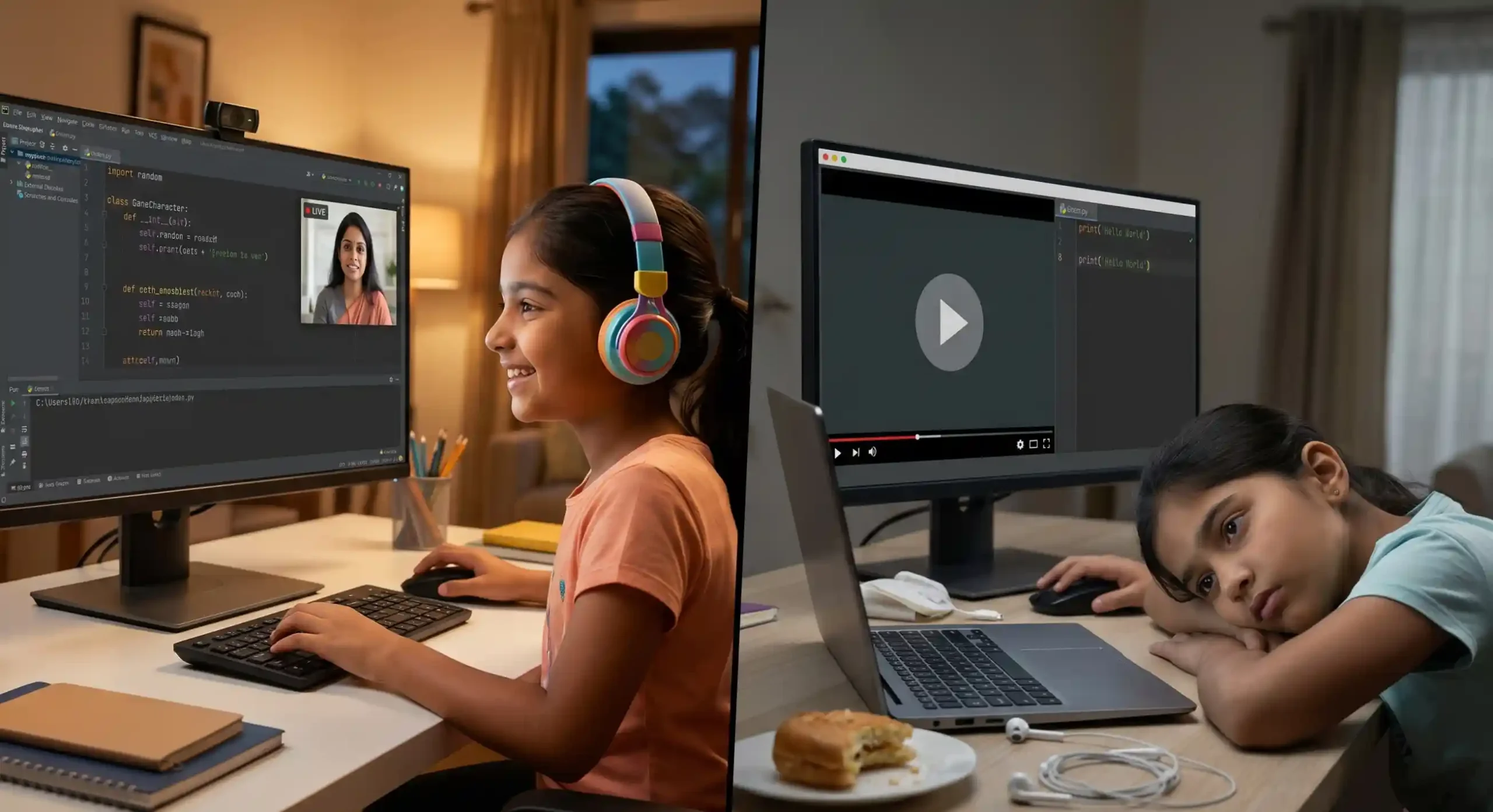
You paid for it. Your child watched two videos, built nothing, and then quietly went back to YouTube. If this sounds familiar, you are not alone.
India’s edtech market crossed Rs. 1,10,000 crore in 2024. Millions of children are enrolled in online coding courses. And yet, less than 25% of students in India complete the digital courses they begin, according to industry research from Ken Research. The vast majority pay, log in once or twice, and disappear.
This is not your child’s fault. It is the format’s fault.
In 2026, Indian parents choosing a coding class for their child have two fundamentally different options: live sessions with a real teacher, or recorded video courses they can access anytime. Both are sold as “online coding classes.” They are not the same thing. This guide tells you exactly what the difference is, who each format suits, and how to decide without wasting money on the wrong one.
What “Live Coding” Actually Means
A live coding class means a real teacher is present with your child in real time over a video call. The teacher sees your child’s screen, watches them type, notices when they are confused, and explains things differently until the concept clicks. The session is scheduled for a specific time. Nobody can skip it without telling someone.
Within live coding, there are two formats. Group live sessions have one teacher and 5 to 15 children simultaneously. The teacher cannot focus on every child. Shy children often hesitate to ask questions. The pace is set by the group, not by your child. Live 1:1 sessions, also called Alpha sessions, have one teacher and one child. The entire session is built around that one child. The pace, the project, the language, the examples are all chosen for that specific learner. There is nobody else to hide behind, and there is nobody else slowing things down.
ForSyntax runs live 1:1 sessions (Alpha) and small group sessions of 2 to 3 children (Beta). Both involve a real teacher in every single class.
What “Recorded Courses” Actually Means
A recorded course is a library of videos. Your child watches a teacher explain something on screen, pauses it, tries to follow along, and then either figures it out or does not. There is no one to ask. There is no one who noticed they went quiet. There is no one who knows whether they understood the last module before moving to the next.
Some platforms dress this up with “live doubt sessions once a month” or an AI chatbot for questions. This is still a recorded course. One group call per month is not a teacher. An AI chatbot is not a teacher. The live doubt session is not what your child needs at the exact moment they are stuck on line 7 of their Python code on a Tuesday evening.
Recorded courses dominate the market because they are cheaper to deliver. One teacher records 50 videos. The platform sells those videos to 50,000 children. The economics work beautifully for the platform. For many of those children, the outcome does not follow.
The Honest Comparison
Here is what actually differs between the two formats, without spin.
Who notices when your child is stuck: In a live 1:1 session, the teacher sees it happening in real time. In a recorded course, nobody notices. Your child either figures it out alone, asks you (if you know coding), or closes the laptop.
What your child actually builds: In a well-run live 1:1 programme, your child builds a real project from the first session. A working Scratch game. A Python quiz. A simple app. They can show it to their grandparents. In most recorded courses, children complete exercises and fill in blanks. There is a meaningful difference between completing an exercise and building something.
Why your child keeps showing up: A scheduled session with a real teacher your child likes creates genuine accountability. There is a person expecting them. Most children do not want to let that person down. Recorded courses have no accountability mechanism. It is easy to abandon something when no one is waiting.
What happens when your child loses interest mid-course: In a live session, a good teacher notices the energy dropping and changes direction. They might switch from Python syntax to building a game that uses the same concept. In a recorded course, the video continues regardless. Interest and boredom are invisible to a pre-recorded screen.
The pace: In live 1:1, the session moves exactly as fast as your child needs. If a concept needs three explanations, it gets three explanations. If your child is ready to sprint ahead, the teacher sprints with them. In a recorded course, the video moves at the pace it was filmed. A child who already understands a concept sits through it again. A child who missed something watches it again alone and may still not understand it.
The cost: Recorded courses are cheaper, sometimes significantly. A full recorded coding curriculum can cost Rs. 3,000 to Rs. 8,000. Live 1:1 sessions cost more because a real teacher’s time is involved every session. ForSyntax Alpha sessions are priced at Rs. 15,000 for an 8-week track. The question is not which costs less. It is which produces an outcome your child can actually use.
Flexibility: Recorded courses win here honestly. Your child can watch at 11pm on a Sunday or pause and rewatch. Live sessions require a scheduled time. ForSyntax offers unlimited rescheduling on Alpha sessions, which addresses most real-life flexibility concerns, but recorded courses are structurally more flexible on timing.
The Number That Changes Everything
That figure comes from the Indian edtech sector’s own internal research, published by Ken Research in 2024. It has been noted across the industry that low engagement and completion rates remain one of the critical challenges in Indian edtech.
Think about what this means practically. If your child enrols in a recorded coding course and follows the average outcome, there is a 75% chance they stop before finishing. They will not have learned to code. They will have watched some videos. These are different things.
In live cohort-based and live 1:1 formats, completion rates are dramatically higher, reportedly 80% or above, because accountability exists in the structure itself. There is a person. There is a schedule. There is a project your child is in the middle of building. Stopping has a cost that stopping a video does not.
When a Recorded Course Actually Makes Sense
This guide is honest, so here is when recorded courses work.
Recorded courses work well for older teenagers who are intrinsically motivated and have prior exposure to coding. A 15-year-old who is already building games and wants to learn a specific new language at their own pace, without the structure of scheduled classes, can get real value from a well-produced recorded course on Udemy or Coursera.
Recorded courses also work as a supplement to live sessions. If your child is in a live 1:1 programme and wants to explore something extra between sessions, a free course on Code.org or Khan Academy fills that space well.
What recorded courses do not work well for are children aged 6 to 13 who are learning to code for the first time. This is the profile that needs a teacher, needs accountability, and needs someone to notice when they are stuck. This is also, not coincidentally, the profile most recorded course platforms are marketed aggressively toward.
When Live 1:1 Coding Is the Right Choice
Live 1:1 is the right format when your child has not coded before and needs to build confidence from scratch. When your child tried a recorded course and quietly gave up. When your child responds to a relationship with a specific adult who believes in them. When you want to see what your child is actually building, not just trust that progress is happening somewhere in a course library.
It is also the right format for neurodiverse learners. Children with autism, ADHD, or dyslexia benefit significantly from the structured, predictable, one-to-one environment of a live 1:1 session. The immediate visual feedback of coding, combined with a teacher who adjusts pacing and communication style in real time, creates a learning context that recorded video cannot replicate. ForSyntax runs a dedicated inclusive wing, ForSyntax Inclusive Alpha, specifically for neurodiverse learners, with educators who have trained in these approaches.
A Simple Decision Framework for Parents
Before booking anything, ask yourself these five questions.
Has your child already tried a recorded course and stopped? If yes, recorded is not the answer. Live is.
Does your child need someone to be accountable to in order to follow through on anything? Most children aged 6 to 12 do. If yes, live is the right format.
Does your child have a specific learning difference that makes group environments difficult? If yes, live 1:1 is the only realistic option.
Are you primarily trying to minimise cost? If this is the overriding factor, a free course on Code.org is a reasonable starting point. But factor in what the actual completion probability is before calling it a saving.
Do you want your child to have something to show at the end? A project, a portfolio, a game they built? If yes, live 1:1 programmes built around project output are the only format reliably producing this outcome.
What to Look For in Any Live Coding Class
Not all live coding classes are equal. Before enrolling your child anywhere, ask the provider these specific questions.
Is a real teacher present in every single session, or are some sessions pre-recorded video with a teacher available for questions? The answer must be: a real teacher in every session.
What does my child build in the first session? The answer must be something visible and working, not an introduction to programming concepts.
Can I reschedule if our week changes? The answer should be yes, with reasonable notice, without losing a session.
What does my child’s project portfolio look like after 8 weeks? Ask to see examples from real students.
How is progress communicated to me as a parent? The answer should include regular parent-teacher meetings or updates, not just a progress bar in a dashboard.
ForSyntax offers all of the above as standard. The Alpha plan is live 1:1 with a personalised roadmap, unlimited rescheduling, and parent meetings whenever you request them.
A Note on AI Coding Tutors
In 2026, several platforms are replacing human teachers with AI tutors in real-time sessions. The AI responds to code, gives hints, and personalises the pace. This is genuinely impressive technology.
For adults learning to code professionally, AI tutors are increasingly effective. For children aged 6 to 13, the evidence is not there yet. What motivates most children to keep coding is the relationship with a specific teacher who knows them, notices them, and cares whether they figure it out. An AI tutor does not have a bad day. It also does not have a good day. It does not remember that last week your child was frustrated and this week they nailed it. It does not know that your child responds better to game examples than maths examples. These human judgements, made in real time, are what a good live teacher does that no current AI tutor replicates for children.
This will change. In 2026, it has not changed enough.
Book a Free Session Before You Decide Anything
ForSyntax offers a free live Alpha trial session. Your child builds something real in the first 60 minutes. You watch. You see whether the format works for your child before spending a rupee on a full programme.
No recorded course offers this because there is nothing to evaluate in a single video. A live session shows you everything. The teacher’s approach. Your child’s engagement. Whether they smile when something works.
Book a free ForSyntax trial session at forsyntax.com. No commitment. No pressure. Just one session where your child builds something and you decide from what you see.
Is live 1:1 coding worth the higher cost compared to recorded courses?
For most children aged 6 to 13, yes. The completion rate difference alone makes the comparison less straightforward than it appears. A recorded course your child never finishes costs whatever you paid for zero outcome. A live 1:1 programme your child completes and builds three real projects during costs more per session but produces a measurable result. Evaluate on outcome probability, not on price per video.
My child is shy and might not talk much in a live session. Is that a problem?
No. Shy children often do better in live 1:1 sessions than in group formats precisely because there is no audience to perform for. It is just your child and one teacher. A good teacher builds the relationship across the first two or three sessions. Most shy children warm up faster than their parents expect.
Can my child do a live coding class if they have autism or ADHD?
Yes. ForSyntax specifically runs an inclusive wing for neurodiverse learners, including children with autism and ADHD. The structure of live 1:1 sessions, with a consistent teacher, predictable format, and immediate visual feedback from coding, suits many neurodiverse learners well. We offer an initial consultation with our academic team before the trial session to make sure the approach is right for your child.
What age is right to start live coding classes?
Most children are ready for structured live coding from age 7. At ForSyntax, we teach children from age 6 upward, using Scratch for younger learners and introducing Python and other languages as the child develops. The right starting point depends more on the individual child than on age.
What if my child misses a session?
ForSyntax Alpha sessions come with rescheduling. Life happens. Missing a session does not mean losing it.
How is ForSyntax different from WhiteHat Jr or Byju’s coding?
ForSyntax is smaller, which is the point. Every child has a consistent teacher across all their sessions, not a rotating roster. Sessions are genuinely 1:1 or a maximum of 2 to 3 children in Beta groups. Parent communication happens whenever you ask for it, not according to a quarterly report schedule. We do not use recorded video in any session.
Will AI replace coding as a skill? Should my child bother learning it?
This is the question every parent is asking in 2026 following statements from senior tech figures that AI will do the coding. The honest answer is that coding is not just about writing syntax. It is about learning how to break a problem into logical steps, how to think computationally, how to build something from nothing. These skills are not replaced by AI. They are made more valuable by it. A child who understands how code works will use AI coding tools far more effectively than one who does not.
